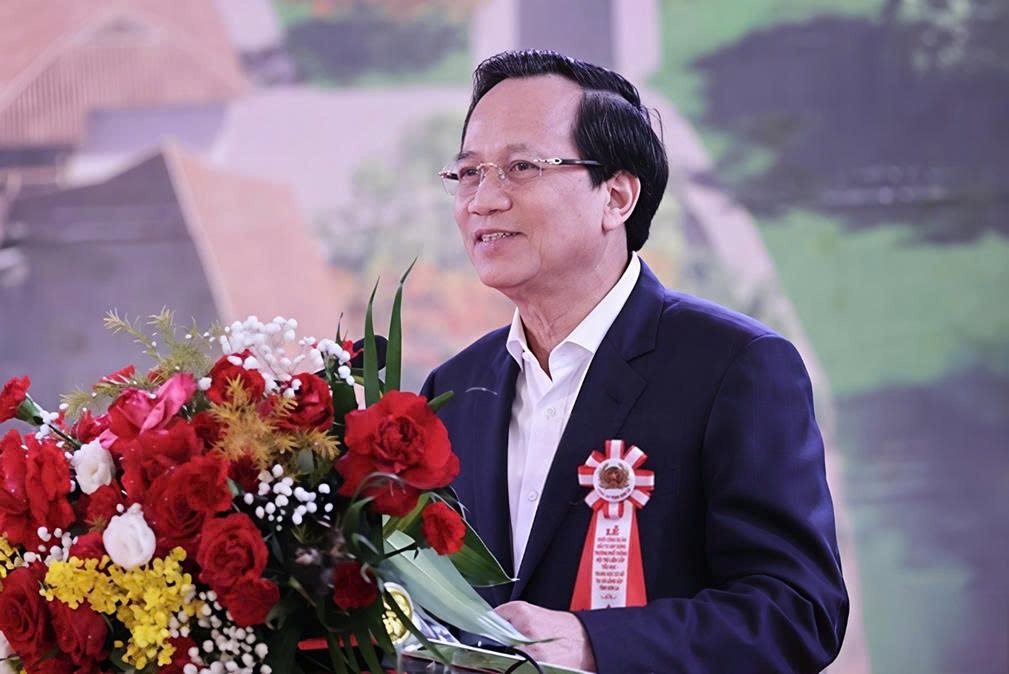
 In the photo: Minister of Ethnic and Religious Affairs Dao Ngoc Dung speaks at the groundbreaking ceremony for a multi-level boarding school in Son La province (on November 9th, 2025).
Keywords: Ethnic affairs; Ethnic minority and mountainous areas; The era of national resurgence.
1. INTRODUCTIONl
Vietnam is a unified, multi-ethnic country. From its inception and throughout its revolutionary leadership, our Party has always recognized that ethnic affairs hold a strategically important position in the glorious revolutionary cause of the Party and the nation. At the same time, it is a key factor in consolidating national unity - a solid foundation for all the victories of the revolution. Entering a new era - an era of deep international integration, digital transformation and knowledge-based economic development - ethnic affairs is increasingly demonstrating its irreplaceable role in ensuring social justice, sustainable development and maintaining political and social stability. Ethnic minority and mountainous areas are facing great opportunities but also many challenges: development disparities, climate change, labor migration, decline of traditional culture and the demands of global integration.
Therefore, researching and accurately assessing the position and role of ethnic affairs in the current period is an urgent requirement, not only to affirm the importance of this field in the national development strategy but also to propose innovative management solutions, improve policies and promote the internal strengths of ethnic minority communities. Therefore, ethnic affairs should be viewed as a pillar in the strategy of Vietnam’s rapid, sustainable, distinctive and integrated development.
2. RESEARCH RESULTS
2.1. Theoretical basis of ethnic affairs and national development
Ethnic affairs activities are understood as activities in the field of ethnic affairs aimed at influencing and creating conditions for ethnic minority communities to develop together, implementing the principles of equality, solidarity, respect, mutual assistance for development and protecting the legitimate rights and interests of ethnic minority citizens. The scientific basis for the Party’s views, policies and guidelines on ethnic affairs is Marxism-Leninism, Ho Chi Minh’s Thought and the Party’s consistent stance on the ethnic issue and national unity. Essentially, ethnic affairs is not just about implementing policies for ethnic minority communities, but also about organizing, mobilizing and leveraging the combined strength of these communities to serve the goals of sustainable development and international integration.
Equality, solidarity and mutual assistance among ethnic groups are prerequisites for building a progressive society. Applying creatively to the Vietnamese context, our Party has determined that the ethnic affairs is closely linked to socio-economic development, ensuring national defense and security, strengthening the people’s trust in the Party and the State and aiming towards the goal of “equality, solidarity, mutual respect and mutual assistance among ethnic groups for common development”. Thus, ethnic affairs carries profound political, social, cultural and humanitarian significance, serving as both the content and the driving force of national development.
In the current context, the theory of ethnic affairs has been broadened based on a sustainable development approach and modern governance. Factors such as human development, cultural preservation, digital transformation, climate change adaptation, and enhanced community participation are considered core elements of ethnic affairs. Integrating ethnic affairs with the national development strategy not only ensures social justice and narrowing regional disparities but also contributing to strengthening internal power, creating a foundation for a diverse, harmonious and unified society towards the goal of “a prosperous people, a strong nation, democracy, fairness and civilization”.
Thus, from a theoretical perspective, ethnic affairs is a pillar of state management for development, a vivid manifestation of the “people-centered” approach in the process of Vietnam’s progress in the new era.
2.2. The role of ethnic affairs in the new era
In the process of national development, ethnic affairs hold a particularly important position in consolidating national unity, ensuring political and social stability and creating momentum for reform and international integration. In the new era, as Vietnam is rising strongly with aspirations for prosperous and powerful development, ethnic affairs is no longer limited to implementing preferential policies and supporting ethnic minority and mountainous areas, but has become a pillar of sustainable development, with national strategic importance.
Firstly, ethnic affairs are a core factor in strengthening the nation's intrinsic power. Ensuring equal rights, respecting cultural identity and creating conditions for ethnic minority communities to participate in the development process helps unleash human potential, transforming cultural diversity into a soft resource for integration and innovation. At the same time, this also serves as a basis for strengthening the people’s trust in the Party and the State and consolidating unity of will and action throughout society.
Secondly, ethnic affairs directly contributes to the goal of sustainable development and multidimensional poverty reduction. Through national programs and projects such as the National Target Program for socio-economic development in ethnic minority and mountainous areas, the State not only invests in infrastructure and improving the lives of ethnic minorities but also promoting economic restructuring, human resource development and linking economic development with cultural preservation and environmental protection.
Thirdly, in the context of globalization and digital transformation, traditional culture plays a bridging role between tradition and modernity. The application of science and technology and digital transformation in management, education, tourism development, and agriculture helps ethnic minority and mountainous areas participate more deeply in national and even global value chains, contributing to narrowing the development gap between regions.
Therefore, ethnic affairs is not only a humanitarian policy but also a development strategy with ideological significance, creating a foundation for the “rise” of the Vietnamese nation, where the strength of diverse cultures is transformed into internal strength for the country to integrate and develop sustainably in the new era.
2.3. The strategic position of ethnic affairs in the current national development
n the process of national development, ethnic affairs are not only a part of social policy but also have strategic importance, closely linked to the goal of building a prosperous, democratic, just and civilized country. The importance of ethnic affairs is increasingly affirmed in the development thinking of the Vietnamese Party and State, viewing it as a key factor in ensuring political stability, consolidating national unity and creating a foundation for sustainable development.
Firstly, ethnic affairs plays a particularly important role in consolidating internal strength and protecting the Fatherland. Vietnam is a multi-ethnic country, where each community possesses its own unique cultural identity, knowledge and development potential. Paying attention to and promoting the role of ethnic minority communities not only demonstrates profound humanism but also contributes to building a solid “people’s support base”, a crucial factor in ensuring national stability and unity amidst global changes.
Secondly, ethnic affairs plays a guiding role in regional development, narrowing the gap between rich and poor and promoting social justice. Ethnic policies, especially the National Target Program for socio-economic development in ethnic minority and mountainous areas have become a driving force for economic restructuring, improving material and spiritual lives and thus contributing to harmonious development nationwide.
Thirdly, in the context of international integration and digital transformation, ethnic affairs holds a strategic position in preserving and promoting national cultural values - an important “soft power” of the nation. The harmonious combination of traditional preservation and innovative creation helps ethnic minority cultures become a resource for developing tourism, education and the knowledge economy.
Thus, today’s socio-economic development program is not just about support and subsidies, but a comprehensive strategy that both ensuring social security and creating momentum for development. This is a crucial component in the strategy for sustainable national development, contributing to affirming the position, capabilities and unity of the Vietnamese people in an era of striving and deep integration with the world.
2.4. The challenges and requirements
In the new era of national development, as Vietnam enters a period of accelerated industrialization, modernization and deep international integration, ethnic affairs are facing enormous challenges that require strategic vision, innovative thinking and high adaptability.
Firstly, the development gap between ethnic minority and mountainous areas and the plains and urban areas remains a prominent and systemic issue. Disparities in infrastructure, education, healthcare, employment opportunities and access to basic social services are hindering equitable and sustainable development. This is not only a socio-economic challenge but also a matter of fairness, stability and national unity.
Secondly, globalization and digital transformation place ethnic affairs before profound changes in cultural, economic and intellectual space. The powerful flow of the market economy, digital media and global values has both created opportunities for ethnic minority communities to participate more deeply in modern life and poses a potential risk of eroding their cultural identity, local knowledge and traditional languages. Balancing integration and preservation, economic development and the preservation of cultural identity is a pressing requirement in current ethnic policy planning.
Thirdly, the need to innovate the model of state management of ethnic affairs towards a modern, effective direction and alignment with sustainable development goals is becoming increasingly clear. The application of digital transformation, big data and science and technology in the management, monitoring, evaluation of ethnic policies is an inevitable trend aimed at enhancing transparency, effectiveness and efficiency in governance.
Fourthly, human resources working on ethnic affairs remain limited in terms of both quantity, quality and skills to adapt to the new context. The requirement is to build a team of officials with professional competence, moral character, a deep understanding of the socio-cultural aspects of ethnic minority and mountainous areas, at the same time possessing a global mindset and the ability to flexibly apply modern management science. This is the key factor in ensuring that ethnic affairs truly become a pillar in the nation’s sustainable development and integration strategy.
2.5. Orientation and solutions to improve the effectiveness of ethnic affairs
As the country enters a new stage of development requiring comprehensive reform, the socio-economic development program needs to be oriented towards sustainable development thinking, with people at the center and culture as the foundation. Firstly, it must be affirmed that the national socio-economic development program is a strategic task for the entire Party and the entire people and must be integrated synchronously into national socio-economic development strategies.
Policy planning should be based on the principles of “equality, solidarity, respect, and mutual support for development”, aiming to narrow regional disparities and improve the quality of life for ethnic minority communities. Regarding solutions, firstly it is necessary to improve the institutional framework and inter-sectoral coordination mechanisms, ensuring uniformity and effectiveness in the implementation of ethnic policies. Investing in infrastructure development, especially transportation, education, healthcare and digital transformation in ethnic minority and mountainous areas must be considered a breakthrough, creating a foundation for sustainable development. At the same time, it is necessary to strengthen the training and development of ethnic affairs officials who possess strong political acumen, in-depth expertise and the ability to adapt to the trend of international integration.
Simultaneously, leveraging the internal strengths of ethnic minority communities through green economic development models, community tourism and cultural entrepreneurship should be considered a priority. Ultimately, ethnic affairs in the new era must be linked to digital transformation, modern governance and international cooperation, aiming to build ethnic minority and mountainous areas into truly dynamic, sustainable development spaces rich in Vietnamese identity.
3. DISCUSSION
Ethnic affairs in the era of national resurgence is not only a pillar in national development policy, but also a measure of the capacity for inclusive and humane social governance. In the context of increasing globalization and international integration, the ethnic issue is no longer limited to poverty reduction or the economic development of specific regions, but has become a crucial element in preserving identity, strengthening national unity and ensuring social justice. Placing ethnic affairs in relation to national sustainable development highlights the necessary shift from a “support” mindset to an “empowerment” mindset, from “development for the people” to “development together with the people”.
A major challenge today is how to ensure that ethnic policies are both consistent with cultural characteristics and meet the demands of modernization and digital transformation. This requires innovation in methods of state management, in socio-economic development models in ethnic minority and mountainous areas, as well as in approaches to education, science and technology. Ethnic affairs should be viewed as an endogenous driving force, contributing to the formation of “national cultural identity” in the process of integration.
Therefore, the research, planning and implementation of ethnic affairs and ethnic policies in the new period need to closely link theory and practice, economic development with cultural preservation and ethnic interests with national interests so that all values of the Vietnamese ethnic communities are harmoniously integrated into the overall development of the country.
4. CONCLUSSION
Ethnic affairs play a crucial role in the national development process, serving as the foundation for consolidating national unity - a vital source of strength that determines the country’s longevity and prosperity. In today’s era of rapid integration and transformation, ethnic affairs are not only a humanitarian policy but also a driving force for sustainable growth and narrowing the development gap between regions and social groups. Improving the effectiveness of ethnic affairs requires comprehensive innovation in thinking, institutions and implementation methods, aiming towards an inclusive development model that considers ethnic minority communities as creative actors, accompanying the nation in the modernization process. When ethnic affairs is properly positioned and their role is fully realized, it becomes a vivid manifestation of a nation united in diversity, sustainable in development and confident in its ability to grow and integrate into the global community.
*Hung Vuong University, Ho Chi Minh City
REFERENCES
1. Report No. 68/BC-BCĐTW dated September 4th , 2019, of the Central Steering Committee on the summary of 15 years of implementing Resolution No. 24-NQ/TW of the 9th Central Committee on ethnic affairs (Resolution No. 24-NQ/TW).
2. Directive No. 1971/CT-TTg dated October 27th, 2011, of the Prime Minister on strengthening ethnic affairs during the period of industrialization and modernization of the country.
3. Ho Chi Minh. (2011). Complete Works, Volume 5, Volume 12. Hanoi: National Political Publishing House.
4. Giang Seo Phu. (2016). Some theoretical and practical issues of state management of ethnic affairs over 30 years of reform. Hanoi: National Political Publishing House.
5. Decree No. 05/2011/ND-CP dated January 14th, 2011 of the Government on ethnic affairs.
6. Decree No. 127/ND-CP dated October 10th, 2024 of the Government amending and supplementing one article of Decree No. 05/2011/ND-CP dated January 14th, 2011 of the Government on ethnic affairs.
7. Decision No. 449/QD-TTg dated March 12th, 2013, of the Prime Minister approving the Strategy for Ethnic Affairs until 2020.
8. Decision No. 2356/QD-TTg dated December 14th, 2013, of the Prime Minister promulgating the action program for implementing ethnic affairs until 2020.
