Keywords: Traditional festival; Folk beliefs; Cultural identity.
1. Traditional festivals in Vietnam
Currently, many different types of festivals exist in Vietnam. Besides traditional festivals, there are also new festivals associated with modern historical or revolutionary events, and festivals organized to promote tourism or commemorate milestones in the founding of localities. Festivals are widely distributed across all regions, from rural to urban areas, from plains to mountainous regions, with a long history of development. Traditional festivals can be classified according to many criteria. Traditional festivals can be classified according to various criteria. In terms of timing, festivals usually take place throughout the year, with spring and autumn being the two most important periods. In terms of organizational scope, festivals are divided into village festivals, regional festivals and national festivals. Furthermore, based on their nature, festivals can be divided into groups such as occupational festivals (agriculture, fishing, commerce), festivals honoring national heroes or those who have contributed to the country and festivals related to religions and beliefs such as Buddhism, Christianity or folk beliefs. Compared to other types of festivals, traditional festivals have three basic characteristics that create a distinct cultural nuance, a unique way of organizing them and evoke different attitudes and emotions in the participants.
Firstly, traditional festivals are closely linked to spiritual life, religion and beliefs, possessing a distinctive sacred character. This is a space belonging to the spiritual world, in contrast to everyday earthly life. Although the festival includes many activities, games, or rituals that appear outwardly secular, such as fertility performances, entertainment or competitions, they are essentially sacred due to their connection with customs and beliefs, such as the veneration of reproductive organs in the Tro Tram festival (Phu Tho province).
Secondly, traditional festivals are a comprehensive and complex folk cultural phenomenon, encompassing many aspects of social life. It encompasses everything from religious practices, rituals, customs, and community interaction, to folk performing arts such as singing, dancing, games and theater as well as competitions, entertainment, food and trade. The diversity and holistic nature of traditional festivals make them a unique form of cultural activity, unmatched by any other traditional cultural form.
Thirdly, the subject of traditional festivals is the community. This community can be a village community, a professional community, a religious or belief-based community, or a city community, and the largest is the national community. Each festival is associated with a specific community and that community is the creator, organizer, participant and beneficiary of the cultural values that the festival brings.
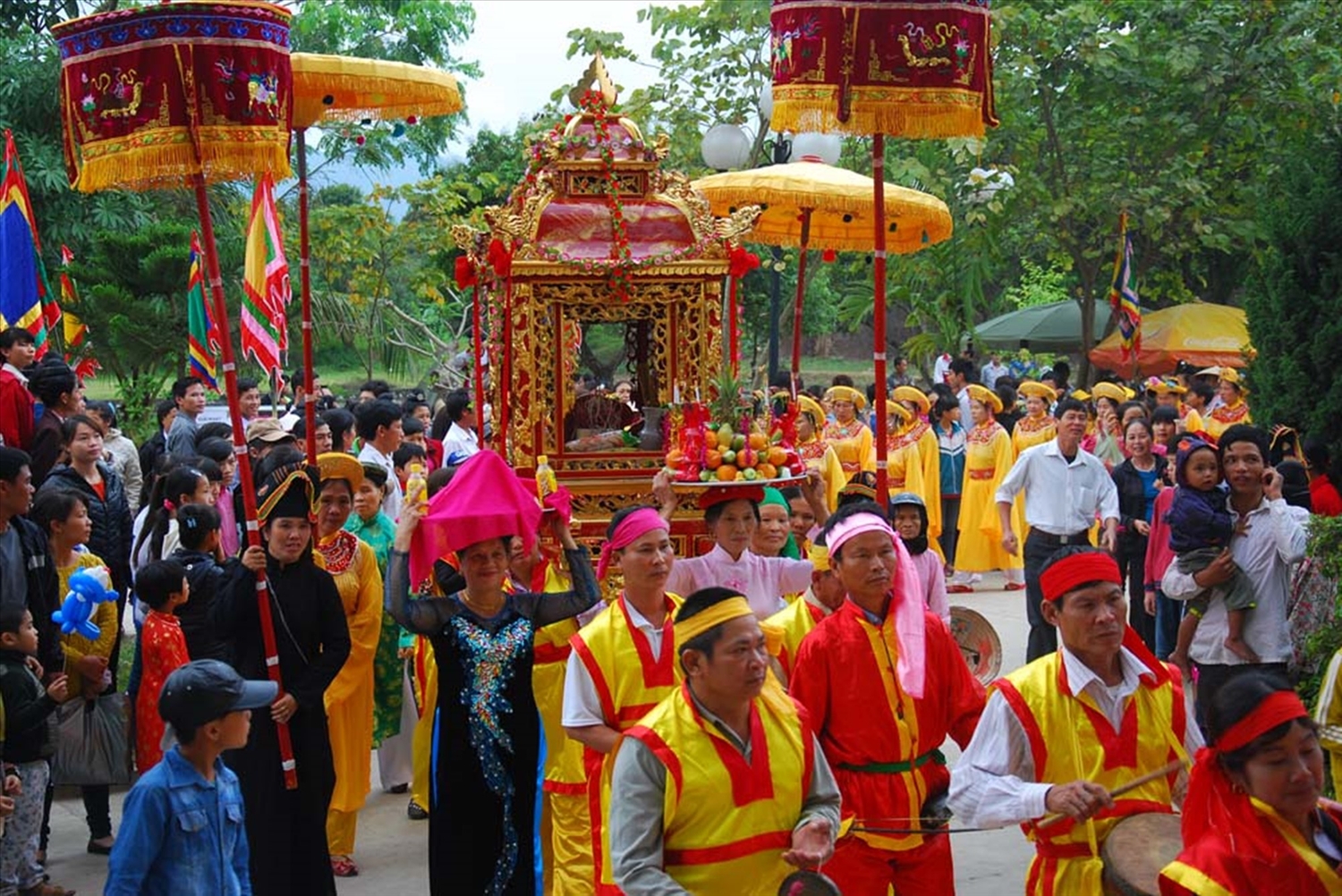 Folk beliefs play an important role in traditional Vietnamese festivals
2. Folk beliefs in traditional festivals in Vietnam
Beliefs are expressions of faith and belief held by individuals and communities in sacred, sublime or venerable things, connected to the human or supernatural world, corresponding to a certain level of social development and awareness. Despite differences in form and level of organization, beliefs and religions are closely related. This distinction not only highlights the difference between the two concepts but also defines the unique folk nature of the belief. Essentially, before a belief develops into a rudimentary religion or folk religion, it is simply a folk belief. Mikhail Bakhtin, a renowned Russian cultural scholar, put forward a principled view on festivals, asserting that: “Festivals (of all kinds) are an important, primitive form of human culture”. He argued that the origins of festivals cannot be simply explained by practical conditions, social labor goals or the need for regular rest. Instead, the festival always contains profound meaning, reflecting a worldview and ideal of life. According to him, no stage in the process of social labor inherently becomes a festival. In other words, festivals originate not only from labor or material means, but more importantly, from the ideals and highest goals of human existence, encompassing spirit, thought and philosophy of life.
Festival activities are closely linked to a system of concepts about time, including cosmic time, biological time, historical time and psychological time (or spiritual time).
Festivals are often held at pivotal moments, marking significant events in nature, history, society or human life, such as the birth or death anniversary of a saint, hero, great figure or occasions related to the re-establishment of crops or occupations. In Vietnam, festivals are concentrated in the spring, especially in the first lunar month in the northern delta provinces, with a high density of celebrations on the fourth, sixth and eighth days of the lunar month. In the Central Highlands, festivals usually take place in March, creating a special sense of sacredness and philosophy on these occasions. The cultural and religious aspects of the festival are reflected in the close relationship between beliefs and festivals as well as the interplay between spiritual culture and community communication culture. These two cultural forms constantly interact, complement and influence each other, highlighting the overall cultural value of folk festivals.
Religious beliefs play a central role as the spiritual, ideological and psychological core, forming the foundation for festival activities, while also combining with cultural values to develop and flourish together. In a festival, the relationship between the ceremonial and celebratory aspects is essentially the connection between religious and cultural elements. The religious aspect brings sacredness and spiritual purification, helping participants feel the solemnity and profound meaning of the festival. Conversely, elements of folk culture and art breathe everyday life into religious practices, making them more relatable to people. This combination reduces the gap between social classes, fosters self-confidence and a spirit of willingness in each individual and softens the rigid rules of doctrines or complex religious rituals. Thanks to this blend, in a festival, both belief and culture not only coexist but also support and nurture each other, creating a unique form of festival that is both rich in spiritual meaning and vibrant, fostering community cohesion.
The relationship between festivals and beliefs reflects the close connection between cause and phenomenon, content and form, as well as between norms, values and symbols. This also represents the connection between religious beliefs and community cultural life. According to researcher Le Hong Ly, “Along with ancestor worship, tutelary deity worship, Mother Goddess worship, agricultural beliefs,... are folk festivals”. These are community cultural activities deeply rooted in the religious beliefs of the Vietnamese people throughout the ages”. Large-scale traditional festivals, as we know them today, all have their roots in the animistic belief system. Initially, these were simple rituals, bringing together a small community within a limited residential area or with a shared desire, appealing to supernatural forces for specific purposes such as praying for favorable weather or avoiding disease. Over time, these rituals expanded in scale, attracting increasingly larger numbers of participants and acquiring new layers of cultural meaning. Besides folk beliefs, the festival is also influenced by foreign religions such as Buddhism, Confucianism and Taoism. Therefore, festivals are not only religious rituals but also become the most comprehensive religious activities, reflecting the distinctive cultural identity of Vietnamese villages.
During the festival, people experience close relationships and free communication, while reintegrating into the community as a spiritual rebirth. Familiar relationships are renewed in the festive atmosphere, helping to dispel the distance, coldness and boredom of everyday life. As a result, various emotions, from neighborly affection and brotherhood to kinship and friendship are all embellished with new nuances. The festival provides an opportunity for each person to feel a return to their true selves and become a meaningful part of the community. Festivals are not just events, but also vibrant expressions of human life itself. Therefore, people often say “going to see a performance” but also "going to attend a festival”, because when participating in a festival, people not only witness but also live in the festive atmosphere. Here, people experience the renewal and rebirth of nature, seasons, life, social relationships and themselves. In that space, people lived according to the rules of freedom, as in crowded gatherings, the custom of catching eels in jars or the custom of extinguishing the lamp, where fertility activities took place naturally and without restraint. The profound significance of the festival lies not only in its perception of time but also in the transformation of space. Festival spaces are a transformation of everyday spaces into special cultural spaces. Familiar images such as village communal houses, banyan trees, village roads, or rice fields suddenly become new, vibrant, sacred and sublime during the festival. Even ordinary places like mounds of earth, tree stumps, or patches of grass seem to be imbued with a soul, becoming part of unique stories, processions and cultural performances. In that space, everything seems to be telling a story, participating in a journey to recreate the cultural and spiritual identity of the community.
When the village holds a festival, attendees are immersed in a cultural space that is both familiar and novel. This harmonious combination brings them new emotions, helps restore psychological and ecological balance and contributes to the further development of positive human qualities. For pilgrims from far away, the festival is also an opportunity to discover a new cultural region, change their cultural environment and experience unique cultural exchanges. Festivals are not only occasions for people to convey their feelings, morals, and aspirations, but also opportunities to connect the past and the present. Through this, the festival strengthens community bonds, awakens cultural pride, and is a way for people to express their reverence for nature, their ancestors and their origins.
Festival spaces are sacred and sublime, often held in locations featuring architectural and artistic structures such as communal houses, pagodas, temples, shrines, palaces, palaces, steles, statues, mausoleums or towers. These structures are not only enduring tangible cultural heritage sites, but also repositories of myths, legends and fairy tales about fairies, gods and Buddhas both celestial and human deities. These are individuals who have made significant contributions to land reclamation, nation-building, fighting foreign invaders, developing industries or leaving behind great moral and intellectual values. The festival is an opportunity to revive those myths, legends and fairy tales, making historical and mythological figures seem to step out of the past to become immortal and blend in with the festival of the present. At the same time, festival activities are always directed towards sacred and noble objects, revered and worshipped by the people, in order to honor cultural norms, values and symbols. With their close connection to folk beliefs, traditional festivals are not only community cultural activities but also deeply imbued with religious identity; they can be called “folk religious festivals”.
Folk religious festivals have become a form of community cultural activity aimed at satisfying the spiritual and cultural needs of the people. Because it strongly expresses the essence and characteristics of cultural beliefs, integrating many forms and levels of folk beliefs, creating diversity and richness in the colors of the festival. In annual cultural life, festival periods are the most important and meaningful times. Therefore, festival-goers always feel at peace with their good wishes, expressing their hopes for peace in the country, favorable weather, abundant harvests and family well-being and prosperity. The behavior of those attending the festival encompasses all four inherent forms of behavior: behavior towards nature, behavior towards the community, behavior towards oneself and behavior towards the divine. It can be said that human behavior during festivals is a manifestation of primitive culture. This is also the philosophy and deepest meaning of the festival. Therefore, the value of folk festivals can be further recognized not only in their reflection of national culture but also in their contribution to the preservation and promotion of national religious and cultural values. A characteristic of this reflection is its symbolic nature. The symbolism of the festival is expressed through rituals, ceremonies, performances, games, processions, emblems, customs, costumes, masquerades and even folk art. The symbols of the festival represent the combination and integration of normative forms and values, elements of national culture. Therefore, folk festivals and beliefs contain many layers of cultural phenomena, cultural identity, humanistic and democratic values that can be promoted in the cause of building an advanced Vietnamese culture rich in national identity.
3. Conclusion
For generations, folk beliefs in traditional festivals in Vietnam have helped Vietnamese people preserve traditional values and create connections. Religious beliefs help people relieve anxieties in life, bring faith in the future; they are also an opportunity for people to gather, share and strengthen community bonds. Folk beliefs in traditional Vietnamese festivals are not only an expression of religious faith but also reflect the rich culture and spiritual values of the nation. This is an indispensable part of preserving Vietnamese cultural identity and traditions, and also represents a great potential for the cultural development in particular and the socio-economic development of the country in general.
References
1. Ngo Duc Thinh, Folk Culture and Beliefs, published by the Institute of Folk Culture, Hanoi, 2001.
2. Ngo Duc Thinh, Traditional festivals in our country, Journal of Communist, February 16th, 2011.
3. Dinh Gia Khanh, On the path to understanding folklore, Social Sciences Publishing House, Hanoi, 1989.
4. Nguyen Quang Le, Identifying cultural identity through traditional Vietnamese festivals, Social Sciences Publishing House, Hanoi, 2011.
5. Nguyen Thu Hien, “In order to preserve the identity and humanistic meaning of traditional festivals”, Nhan Dan newspaper, February 4th, 2014.
