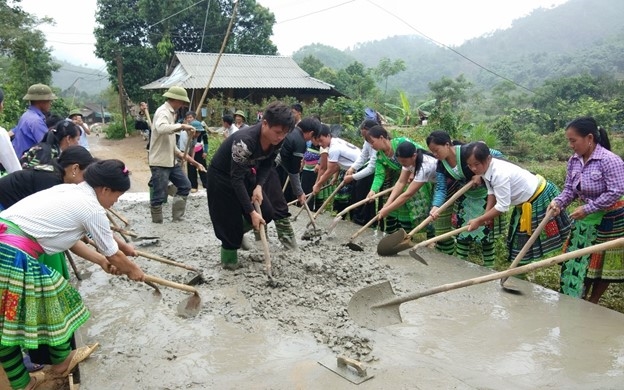
 The role of ethnic minority communities as key players in the development process is one of the key aspects of reforming socio-economic governance methods in ethnic minority and mountainous areas
Keywords: Innovating management methods; Ethnic minority and mountainous areas; Ethnic policy; Vietnam.
1. Introduction
Ethnic minority and mountainous areas hold a strategic position in socio-economic development, ensuring national defense and security and preserving ethnic cultural identity. However, this is also an area facing many difficulties and has a significant development gap compared to other regions. In this context, ethnic affairs should not only focus on supporting development but also require an effective and dynamic governance framework that is modern and appropriate to the specific conditions of each region.
The practical implementation of ethnic policies in recent years has shown that, despite achieving many important accomplishments, traditional governance methods still reveal limitations such as bureaucratic nature, fragmentation, lack of coordination and failure to fully utilize the role of the community as the main actors. In particular, in the context of implementing ethnic policies in an integrated, multi-objective, and sustainable manner, these limitations become even more apparent and require fundamental solutions.
Therefore, reforming the methods of socio-economic governance in ethnic minority and mountainous areas is of urgent importance both theoretically and practically. This is not just an adjustment in tools and management methods, but also a shift in mindset from “management” to “development governance”, placing the people at the center and leveraging community strengths. Researching this issue contributes to clarifying the need for innovation in the new context, thereby improving implementation effectiveness and promoting inclusive and sustainable development.
2. Research results
2.1. Current methods of socio-economic management in ethnic minority and mountainous areas
Over the years, the socio-economic governance methods of ethnic minority and mountainous areas in Vietnam have undergone positive changes, especially in the context of implementing ethnic policies towards integration and sustainable development. The governance system has been gradually strengthened with the participation of many stakeholders, from the central to local levels, contributing to promoting socio-economic development, improving socio-economic infrastructure and raising the living standards of the people.
On the positive side, the governance approach has tended to shift from decentralized to integrated, clearly demonstrated through the implementation of national target programs (Decision No. 1719/QD-TTg dated October 14th, 2021 of the Prime Minister: Approval of the National Target Program for Socio-Economic Development of Ethnic Minority and Mountainous Regions for the period of 2021-2030, Phase I: from 2021 to 2025; Decision No. 90/QD-TTg dated January 18th, 2022, of the Prime Minister: Approving the National Target Program for Sustainable Poverty Reduction for the period of 2021-2025; Decision No. 263/QD-TTg dated February 22nd, 2022, of the Prime Minister: Approving the National Target Program for New Rural Development for the period of 2021-2025) and other government policies, contributing to strengthening policy linkages and improving the efficiency of resource allocation. The coordination mechanism between ministries, departments, and localities has been gradually improved, creating favorable conditions for policy implementation. At the same time, the role of local authorities in regional development governance has been enhanced, contributing to increased flexibility and adaptability to specific conditions.
However, the current governance methods still reveal some limitations. Firstly, the governance methods are still heavily bureaucratic and have not truly shifted to a dynamic, modern governance model that puts the people at the center… Many policies are still designed and implemented from the top down, failing to fully leverage the role of ethnic minority communities as key stakeholders in the decision-making and implementation monitoring processes.
Furthermore, the implementation of integrated and synchronized policies is still not highly effective, lacking consistency and exhibiting overlaps, duplications and a lack of linkages between different sectors. This leads to implementation effectiveness that is not commensurate with the invested resources. Inter-sectoral and inter-level coordination mechanisms remain limited, while governance capacity at the grassroots level does not meet requirements, affecting the quality and effectiveness of policy implementation.
Furthermore, the application of digital platforms and digital transformation in governance remains limited, potentially widening the digital divide between ethnic minority and mountainous areas and other areas. People’s livelihoods are not sustainable, the quality of human resources is low and their ability to adapt to socio-economic changes is limited. In some cases, cultural preservation efforts have not been effectively linked to economic development, leading to the risk of traditional values fading away.
The limitations mentioned above indicate that the current socio-economic governance methods do not fully meet the requirements of the new ethnic policy context. Therefore, reforming governance methods is of particular importance, not only to improve policy effectiveness but also to create a foundation for sustainable and inclusive development, contributing to narrowing regional disparities and strengthening national unity in the current period.
2.2. Content of innovation in socio-economic governance in ethnic minority and mountainous areas
Firstly, reforming the governance system is a core element, aimed at overcoming the fragmentation and overlapping of policies. Implementing integrated and synchronized programs and projects in an interdisciplinary and multi-objective manner not only improves the efficiency of resource allocation but also creates unity in development direction. At the same time, it is necessary to improve the legal framework in a way that is flexible, appropriate to the specific characteristics of the region, and enhances its adaptability in the new context.
Secondly, the model and entities of governance should be reformed towards a multi-level, multi-stakeholder approach, in which local governments play a central role in implementation, while ethnic minority communities are identified as the main actors in the development process. The shift from “support” to “empowerment” is a key highlight, contributing to the development of internal strengths and enhancing the initiative and responsibility of the people.
Thirdly, innovate management methods and tools, especially by applying digital platforms and digital transformation in the management and provision of public services. Digitizing data, enhancing information transparency, and improving access to services will contribute to improved governance efficiency and narrow the digital divide between regions.
Fourthly, it is necessary to link development governance with the preservation and promotion of cultural values, considering culture as an important endogenous resource. Integrating cultural sector governance with economic development, especially community-based tourism, will create new impetus for sustainable development.
Overall, the innovation in management methods is not only about adjusting management techniques but also reflects a fundamental shift in development thinking. This is of great importance in improving the effectiveness of ethnic policies, promoting inclusive development and strengthening national unity in the new context.
2.3. The significance of innovating socio-economic governance methods in ethnic minority and mountainous areas
The innovation of socio-economic governance methods in ethnic minority and mountainous regions has profound theoretical and practical significance, reflecting a fundamental shift in development thinking and policy implementation in Vietnam today.
Firstly, reforming governance methods contributes to improving the effectiveness and sustainability of ethnic policies. The shift from an administrative management model to a development-oriented management model enhances integration, reducing policy overlaps and optimizing resource utilization. In this way, programs and projects not only achieve short-term goals but also create a foundation for long-term, stable development.
Secondly, governance innovation is crucial in promoting inclusive development and narrowing regional disparities. When governance is people-centered and leverages community strengths, vulnerable groups, especially ethnic minorities, will have the opportunity to participate more deeply in the development process, thereby increasing their income, improving their quality of life and reducing inequality.
Thirdly, reforming governance methods contributes to enhancing transparency, accountability and operational efficiency of the state management system. The involvement of multiple stakeholders, including the government, businesses and the community, creating a multi-faceted oversight mechanism, improving governance quality and social trust.
Fourthly, governance innovation is also significant in preserving and promoting national cultural values, closely linking economic development with the preservation of cultural identity. This is an important factor in ensuring the sustainability and uniqueness of regional development.
Fifthly, in the context of digital transformation and international integration, innovating governance methods helps to enhance the adaptability and integration of ethnic minority and mountainous areas, expanding opportunities to access resources and markets.
Thus, reforming governance methods is not only an essential requirement but also a crucial driving force for comprehensive and sustainable development in the current period.
2.4. The challenges posed by the current reform of socio-economic governance methods in ethnic minority and mountainous areas
In the context of implementing ethnic policies towards integration and sustainable development, the process of reforming socio-economic governance methods in ethnic minority and mountainous areas is raising many issues that need to be identified and addressed systematically.
(1) Institutional challenges and policy synchronization remain prominent issues. Although there is an integrated orientation, in reality, the policy system still shows signs of fragmentation and lack of linkage between fields and management levels. This affects coordination efficiency and reduces the overall impact of development governance.
(2) The administrative capacity of local governments, especially at the grassroots level, is limited. The transition from management to governance requires staff to have new thinking, interdisciplinary skills and high adaptability, while human resources in many areas are still lacking and weak.
(3) The socio-economic development gap and the digitalization gap between ethnic minority and mountainous regions and other regions continue to be major obstacles. The application of digital transformation in governance is slow and digital infrastructure and skills are uneven, affecting people’s access to services and development opportunities.
(4) The role promotion of ethnic minority communities as key stakeholders has not yet met expectations. People’s participation in policy formulation and monitoring remains limited, reducing the sustainability of development programs.
(5) The relationship between economic development and cultural preservation presents many challenges, especially in the context of rapid integration and social change. Without appropriate governance mechanisms, the risk of cultural identity erosion is ever-present.
These issues demonstrate that reforming the socio-economic governance methods of ethnic minority and mountainous areas is not only an essential requirement but also a complex process, demanding synchronized adjustments in institutions, capacity and organizational implementation methods to ensure effectiveness and sustainability in regional development.
2.5. Orientation and solutions for innovating socio-economic management methods in ethnic minority and mountainous araes today
In the context of implementing ethnic policies towards integrated, sustainable, and inclusive development, the innovation of socio-economic governance methods in ethnic minority and mountainous areas needs to be comprehensively oriented, linked to the requirements of modernizing national governance.
Firstly, it is necessary to improve the governance system in a way that is synchronized, integrated and flexible, overcoming the situation of fragmented and overlapping policies. Establishing an effective inter-sectoral coordination mechanism that links national target programs with ethnic policies is a key solution to improving the efficiency of resource utilization.
Secondly, the governance model should be reformed towards a multi-level, multi-stakeholder approach, with increased decentralization and delegation of power to local authorities coupled with enhanced accountability. At the same time, it is necessary to promote the role of ethnic minority communities as a central subject in the development process, shifting from “beneficiary” to “participation and co-governance”.
Thirdly, improving the management capacity of staff, especially at the grassroots level, through training and fostering modern, interdisciplinary management skills and adapting to the context of digital transformation. This is a prerequisite for effectively implementing innovation orientations.
Fourthly, it is necessary to promote the application of digital transformation in development management, invest in digital infrastructure, building databases and enhancing digital skills for citizens, thereby narrowing the digital divide and improving the efficiency of public service delivery.
Fifthly, emphasis should be placed on linking economic development and the preservation of traditional culture, considering culture as an important endogenous resource for sustainable development, especially in the development of community tourism and local livelihoods.
These guidelines and solutions not only contribute to improving governance efficiency but also demonstrate the profound significance of innovating governance methods, aiming for inclusive and sustainable development and strengthening national unity.
3. Discussion
The innovation in socio-economic governance methods for ethnic minority and mountainous regions in the new context reflects a fundamental shift from an administrative management model to a modern development governance model. From a theoretical perspective, this approach aligns with the new trend in public administration, emphasizing multi-level, multi-stakeholder governance and the central role of citizens. However, in practice, this transition is facing numerous challenges that need to be considered comprehensively.
Firstly, there is a significant gap between policy and implementation, especially at the grassroots level, where governance capacity is limited and resources are insufficient. This shows that reforming governance methods is not just about policy changes, but also requiring synchronized reforms in institutions, organizations and human resources. Furthermore, policy integration and inter-sectoral coordination have not been as effective as expected, reducing the coherence of development governance.
From a practical perspective, promoting the leading role of ethnic minority communities remains a key issue, but it has not been fully implemented. Without genuine empowerment mechanisms, governance innovation will struggle to achieve sustainability. Simultaneously, digital transformation and international integration place new demands on the adaptability of governance systems.
However, innovation in governance methods also opens up great opportunities to improve policy effectiveness, promote inclusive development and narrow regional disparities. Therefore, it is necessary to continue improving the governance model towards flexibility, integration and a people-centered approach, in order to ensure feasibility and effectiveness in the new development context.
4. Conclusion
Innovating the methods of socio-economic governance in ethnic minority and mountainous areas in the new context is an essential requirement, reflecting the shift from administrative management to modern, inclusive and sustainable development governance. Putting people at the center, leveraging community strengths and enhancing policy integration have been and continue to be the foundation for improving governance effectiveness. However, to achieve long-term goals, it is necessary to continue improving institutions, enhancing governance capacity and promoting genuine community participation. The significance of innovating governance methods not only lies in policy effectiveness but also contributes to narrowing the development gap, preserving and promoting the traditional cultural values of ethnic groups and consolidating the great national unity bloc in the current period.
* Ministry of Ethnic and Religious Affairs
** Journal of Ethnic and Religious Research
References
1. Nguyen Duy Dung (2025), Preserving cultural identity in the goal of poverty reduction for ethnic minorities: Theory and practice in the Central Highlands, Journal of Ethnic and Religious Research, No. 1 (September).
2. Conclusion No. 65-KL/TW dated October 30th, 2019, of the Politburo on continuing to implement Resolution No. 24-NQ/TW of the Central Committee of the 19th Party Congress on ethnic affairs in the new situation.
3. Decision No. 1719/QD-TTg dated October 14th, 2021, of the Prime Minister: Approving the National Target Program for socio-economic development of ethnic minority and mountainous areas for the period of 2021-2030, Phase I: from 2021 to 2025.
