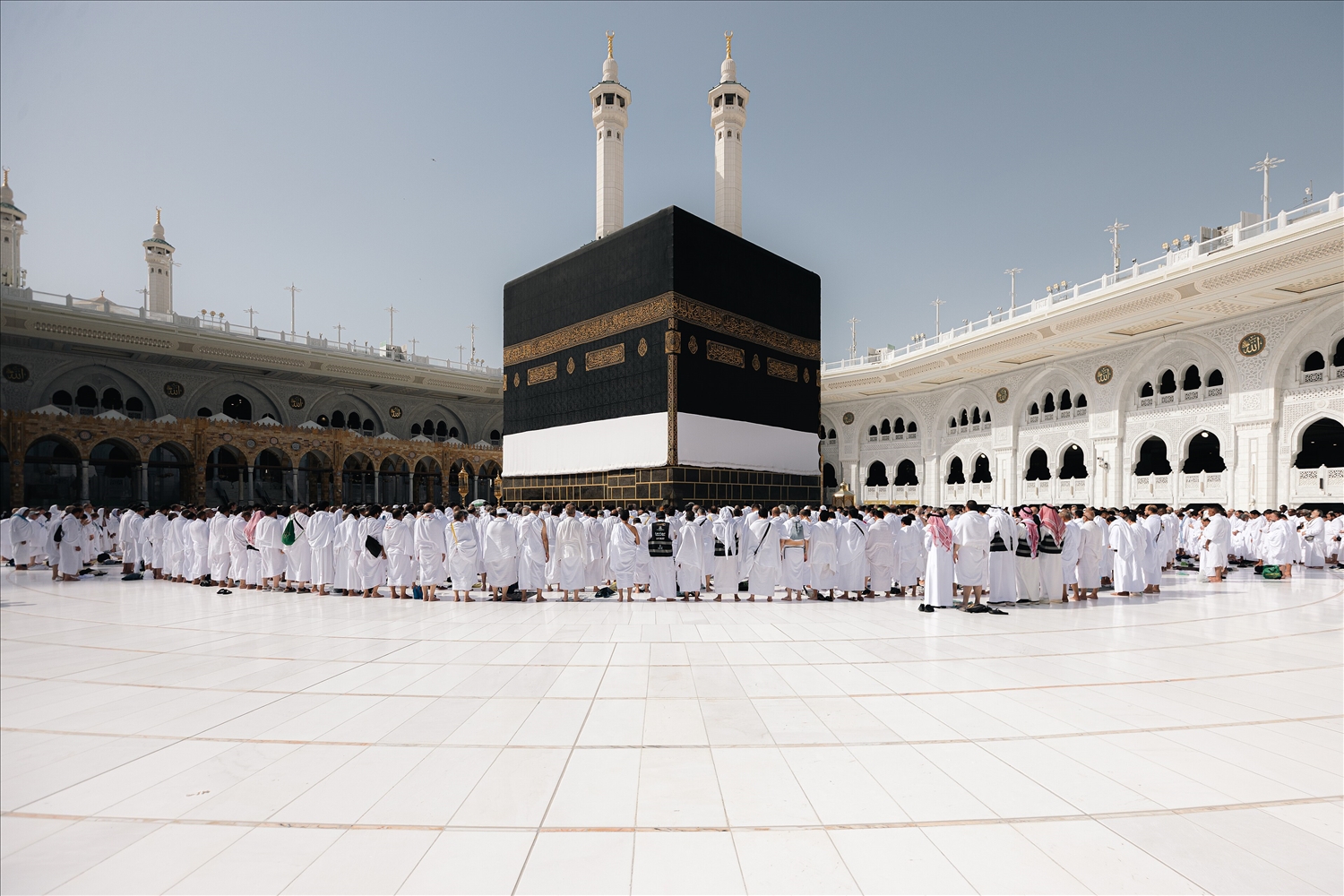
 The world’s largest Islamic holy site is located in the city of Mecca, in the west of the Kingdom of Saudi Arabia
According to Islamic tenets, every believer must undertake a pilgrimage to Mecca at least once in their lifetime, particularly during Ramadan and must personally fund the journey. This is not merely a religious obligation but also an expression of devotion and a profound spiritual connection with the Almighty. Upon arriving in Mecca, believers participate in prayers within the Holy Mosque, seeking goodness and blessings. This is a distinctive feature of Islam, reflecting the seriousness and respect with which adherents hold their faith.
At the heart of Mecca lies the Masjid al-Haram, the largest Islamic structure in the world. Situated at the center of the mosque is the Kaaba, a cube-like structure draped in a black cloth embroidered with gold thread. In Islamic theology, the Kaaba is known as Bayt Allah (the House of God); it symbolizes the Divine presence and serves as the focal point toward which all believers worldwide must turn when performing their five daily prayers. The sight of hundreds of thousands of worshippers, clad in simple white attire, moving counter-clockwise around the Kaaba during the Tawaf ritual creates a truly striking visual and spiritual spectacle. This ritual signifies absolute equality before the Almighty, where all boundaries of ethnicity, race, social status and wealth are completely erased.
Beyond the symbolic significance of the Kaaba, Mecca preserves numerous important historical and religious landmarks within its various spaces. Located within the Grand Mosque complex itself is the legendary Zamzam Well. According to Islamic tradition, this water source appeared through divine intervention to save Hajar and her son Ismail in the midst of the barren desert. The water of Zamzam, which has flowed continuously for millennia, is not only a symbol of divine grace and vitality, but also an inseparable part of the spiritual life of believers. Not far from the Grand Mosque lie the hills of Safa and Marwa, the site of the Sa’i ritual, a journey involving a brisk walk between the two hills that reenacts Hajar’s persistent search for water. Every landmark in Mecca is imbued with a rich tapestry of religious memory, linking the historical past with the practice of faith in the present.
One cannot speak of Mecca without mentioning the Hajj pilgrimage, one of the five mandatory pillars that every Muslim with the physical and financial means must undertake at least once in their lifetime. Taking place during the twelfth month of the Islamic calendar, the Hajj transforms Mecca into the planet’s largest gathering place for humanity. The sequence of rituals stretching from the Grand Mosque to the valley of Mina, the station at the Plain of Arafat and the symbolic stoning of the devil at Jamarat, demonstrating an extraordinary capacity to organize and coordinate sacred space on a massive scale. The Hajj pilgrimage stands as a testament to a profound power of communal connection, where people from every continent transcend cultural differences to find complete spiritual harmony in their shared faith.
In the modern era, Mecca not only preserves its traditional spiritual atmosphere but also undergoes rapid urbanization and significant infrastructure upgrades to accommodate the ever-growing scale of pilgrimages. The Abraj Al-Bait clock tower, standing tall right next to the Grand Mosque, exemplifies the juxtaposition of the Kaaba’s ancient solemnity and the modern, majestic scale of Abraj Al-Bait in serving the faithful.
Despite being one of the world’s most popular destinations, Mecca enforces strict regulations regarding access, with the city open only to Muslims. This regulation is not intended to create division, but rather to preserve authenticity and sanctity while ensuring absolute security for pilgrimage rituals. Mecca represents a unique embodiment of the power of faith, a place where historical, social and spiritual values converge upon a single, supreme focal point./.
