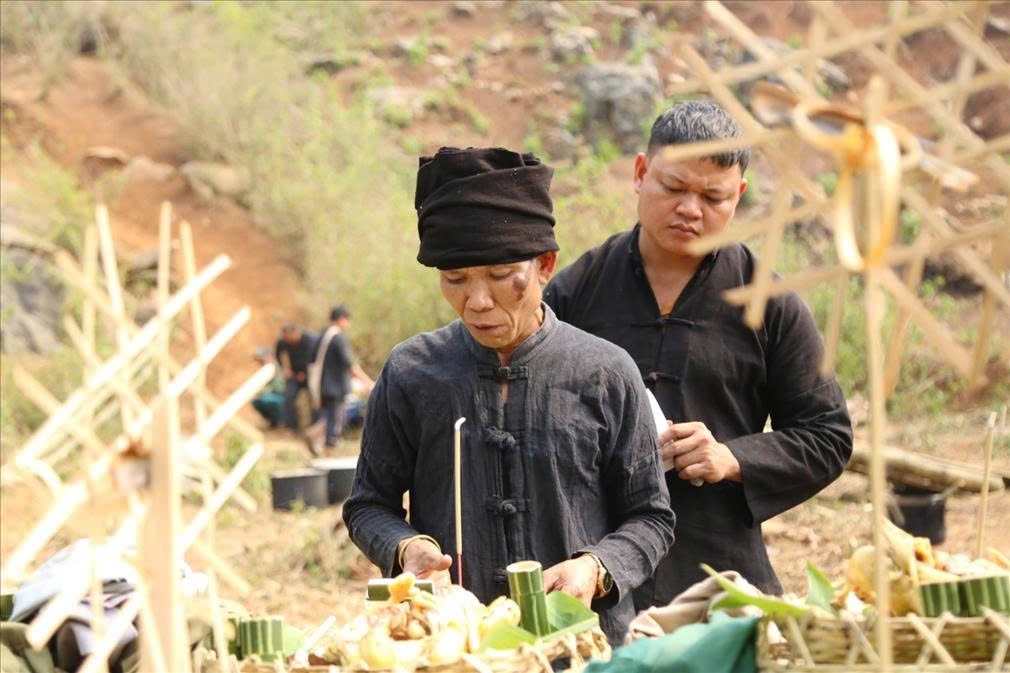
 The Khang ethnic group’s custom of worshipping the forest god conveys the message of forest protection and is one of the customs that directly supports environmental criteria in building new rural areas
Keywords: Relationship; Traditional customs and practices; Ethnic minorities; Ethnic minority and mountainous areas; New rural areas.
1. Introduction
The New Rural Development program is a national target program of strategic significance of the Party and State aimed at promoting comprehensive development in rural areas, improving the quality of life and narrowing the development gap between regions. In particular, ethnic minority and mountainous areas are identified as a priority area due to their unique natural, socio-economic, and cultural conditions; however, the process of building new rural areas in these regions also presents many challenges.
One of the defining elements of development in ethnic minority and mountainous areas is the system of customs and traditions, the socio-cultural norms that have been formed, maintained and operated for a long time within the community. This system not only regulates individual behavior and community relations, but also has a profound impact on how we produce, consume, manage resources, access education and healthcare and organize our lives.
In the context of the New Rural Development Program, which requires comprehensive transformation in infrastructure, livelihoods, environment, and community institutions, the relationship between customs and traditions and the implementation of the New Rural Development Program becomes an issue that is both theoretical and practical. Customs can be an important endogenous resource supporting consensus, cohesion and sustainable development; but they can also be a barrier if they are conservative, outdated or conflict with existing laws and regulations.
Therefore, it is important to clearly identify the dual nature of customs and traditions, analyzing its compatibility or conflict with the New Rural Development criteria, simultaneously, proposing flexible approaches that respect local culture in the process of building new rural areas in ethnic minority and mountainous areas is an urgent requirement both in theory and policy planning.
2. Research results
2.1. Theoretical and practical basis
a) Concept and scope of research
Customs and traditions are systems of social norms of behavior that are formed, passed down and enforced within a community over time, they are self-regulating, stable and capable of influencing individual behavior within the framework of cultural norms. From an anthropological and legal perspective, customs and traditions can be seen as a cultural institution, playing a role in maintaining order, strengthening social structure and reflecting human adaptation to specific ecological and historical conditions.
The New Rural Development Program is a comprehensive development policy based on a system of criteria covering the economy, infrastructure, environment, culture, institutions and rural security, with the goal of improving the quality of life and narrowing the development gap between regions. In ethnic minority and mountainous areas, where socio-cultural characteristics are unique, the implementation of the New Rural Development program cannot be separated from the context of local customs and traditions.
The research focuses on the customs and traditions and the process of implementing the New Rural Development program in ethnic minority communities in Vietnam. The focus is on identifying cultural factors that positively or negatively impact the implementation of New Rural Area criteria, thereby proposing appropriate policy approaches to reconcile the preservation of traditional values with the promotion of modern, sustainable development.
b) The role of customs and traditions in the community life of ethnic minorities
In ethnic minority communities, customs and traditions are not only forms of cultural expression but also play a role as an informal social institution system, maintaining the stability, cohesion and identity of the community. The customs and traditions is formed on the basis of long-standing historical and ecological experience, fulfilling the functions of regulating behavior, assigning social roles, managing resources, organizing beliefs, providing moral education and guiding lifestyles. Customs and customary laws contribute to maintaining community order through forms such as village regulations and conventions. The role of village elders, community leaders and influential individuals is seen as an “intermediary institution” between the state and the community. These principles are often flexible and easily accepted within culturally homogeneous communities with strong kinship ties. At the same time, customs and traditions are endogenous cultural resources, reflecting characteristic value systems such as respect for nature, emphasis on community spirit, frugality, solidarity and mutual assistance. This forms the basis for maintaining the sustainability of livelihoods, traditional production models and social institutions that adapt to challenging geographical, economic and infrastructure conditions.
However, in the context of modernization and rural restructuring, customs and traditions also reveal a dual nature that can become barriers if they are conservative, restricting access to development opportunities (especially for women and youth), or conflicting with the law and sustainable development standards. Therefore, accurately assessing the role of customs and traditions is a crucial basis for developing more localized and sustainable rural development policies in ethnic minority and mountainous areas.
2.2. The relationship between customs and traditions and the construction of new rural areas
a) Positive effects
The customs and traditions of ethnic minority communities contain many valuable elements that can be utilized as an endogenous resource in the process of building new rural areas, especially in social, cultural and community governance aspects.
Firstly, customs and traditions contribute to strengthening social cohesion and consensus, which are fundamental conditions for mobilizing the community to participate in rural development activities such as infrastructure development, environmental protection and maintaining security and order. The role of village elders, community leaders and influential individuals, along with traditional social institutions, facilitates the mobilization, dissemination of information and implementation of new rural development criteria in villages and hamlets.
Secondly, the system of traditional customs and traditions is a positive cultural resource, contributing to the realization of criteria for building a cultured way of life, preserving national identity, traditional festivals and community living spaces. Integrating local cultural values into new village regulations and customs has created conditions for the formation of new rural models that are suitable to the local socio-cultural characteristics.
Thirdly, many customs and traditions reflect a community’s ecological awareness and sustainable resource management, such as customary laws protecting headwater forests, water sources and arable land, or regulations on collective land use and livestock grazing. These principles can directly support the implementation of environmental and sustainable development criteria in the New Rural Development Program.
Fourthly, customs also serve as an important mechanism for resolving internal conflicts within the community through traditional reconciliation, helping to reduce the burden on local authorities and creating conditions for maintaining stability and security during the development process.
Therefore, when identified, selected, and applied appropriately, positive customs and traditions can act as social catalysts, helping the New Rural Development Program become culturally appropriate, socially sustainable and effective in community governance.
b) These influences are barriers
Besides its positive values, the customs and traditions of ethnic minority communities also contain many elements that are no longer suitable in the modern context, becoming obstacles to the effective implementation of the New Rural Development Program.
Firstly, some outdated production practices such as nomadic farming, traditional farming methods, free-range livestock, and uncontrolled resource exploitation negatively impact the fulfillment of criteria for economic development, environmental protection and sustainable resource management. These practices not only reduce production efficiency but also put ecological environment pressure on the community.
Secondly, costly and lengthy wedding, funeral and religious ceremonies and customs increase household expenses, potentially leading to debt or renewed poverty; depleting accumulated resources and hindering the goals of improving living standards, income criteria and building a new cultural life.
Thirdly, conservative thinking, a closed-minded attitude and reluctance to embrace new knowledge are major obstacles to livelihood transformation, the application of science and technology and the adoption of training programs and agricultural and forestry extension services. Many communities still heavily rely on a self-sufficient mindset, failing to proactively participate in market institutions and public services.
Fourthly, conflicts between traditional customary law and the current legal system on issues such as gender equality, inheritance rights, dispute resolution, land management,… can undermine the rule of law in community governance. Customary law sometimes becomes a barrier to protecting the rights of women, children and vulnerable groups.
If these issues are not identified and addressed properly, they will reduce the effectiveness of policy implementation and may even create a gap between the government and the people. Therefore, implementing the New Rural Development program in ethnic minority and mountainous areas requires a soft intervention strategy, based on a deep understanding of local culture and mechanisms for sustainable behavioral transformation, rather than imposing development models indiscriminately.
3. Discussion
Building new rural areas in ethnic minority and mountainous areas cannot be done mechanically by applying common standard models, but requires a multi-dimensional approach that adapts to the specific socio-cultural conditions. The diversity of ethnicities, languages, levels of development, ecological conditions and local value systems necessitates the establishment of a flexible implementation approach that harmoniously combines the preservation of traditional culture with the promotion of modernization.
Firstly, the approach to new rural development should be community-based, people-centered and respectful of local voices and knowledge, rather than simply benefiting from top-down policies. In there, the role of village elders, community leaders, influential individuals and traditional institutions should be recognized as important intermediary forces in the process of communicating policies, mobilizing resources and monitoring the implementation of new rural development criteria at the grassroots level.
Secondly, a differentiated approach is needed in ethnic minority and mountainous regions. It's impossible to equate all ethnic minority communities; instead, we must identify the specific anthropological, cultural, farming practices and access to public services characteristics of each group to design appropriate policies. The criteria for New Rural Development also need to be localized in a flexible manner, instead of rigidly applying the lowland model to mountainous, remote and isolated areas.
Thirdly, we need to shift from a purely administrative-technical approach to a cultural and institutional approach. Customs and traditions should not only be considered as objects for “reform”, but also as informal institutional resources that can support the strengthening of community governance, maintain social order and promote sustainable social participation. The development of new village regulations and conventions should incorporate the positive values of tradition while adjusting outdated elements through cultural dialogue rather than administrative coercion.
Fourthly, the approach to new rural development in ethnic minority and mountainous areas needs to be linked to the theoretical framework of sustainable cultural development, emphasizing the maintenance of cultural diversity as a constituent element of development. Building new cultural institutions, organizing festivals, planning villages, developing community tourism or preserving traditional cultural spaces should be integrated as part of the New Rural Development strategy, rather than being treated as separate, supplementary activities.
Fifthly, it is necessary to ensure inter-sectoral and multi-level coordination, in which all levels of government, socio-political organizations, research institutes and development organizations participate from policy design to implementation, monitoring and evaluation. Only when customs and traditions are systematically understood and integrated into the planning process for rural development in ethnic minority and mountainous areas can the New Rural Development program become not only technical and economic in nature, but also deeply humane and culturally appropriate.
4. Conclusion
The customs and traditions of ethnic minority communities are an essential component of the local socio-cultural system, playing a role not only in shaping ethnic identity but also in organizing life, regulating social relations and managing the community. In the context of implementing the National Target Program for building new rural areas, customs and traditions are both an endogenous resource and an institutional challenge if not properly recognized and handled scientifically, flexibly.
References
1. Ministry of Agriculture and Rural Development (2016). Report on the implementation of the national target program for building new rural areas in the period of 2016-2020.
2. Government (2018). Resolution No. 24/2008/NQ-CP dated October 28th, 2008, promulgating the Government’s Action Program to implement the Resolution of the 7th Conference of the Central Committee of the Communist Party of Vietnam (10th term) on agriculture, farmers and rural areas.
3. Thanh Chung (2019). Building new rural areas in the northern mountainous region: “Necessity is the mother of invention”. https://baochinhphu.vn/xay-dung-nong-thon-moi-o-mien-nui-phia-bac-cai-kho-lo-cai-khon-102259608.htm.
4. Nguyen Duy Dung. (2018). Psychology and perceptions of ethnic groups in building new rural areas in ethnic minority and mountainous areas today. Journal of Front, No. 178+179 (June+July).
5. Le Thi Thanh Huong (2015). Some psychological factors of farmers affecting the process of building new rural areas. Hanoi: Social Sciences Publishing House.
6. Resolution No. 19-NQ/TW, dated June 16th, 2022, of the 5th Plenum of the 13th Central Committee, “On agriculture, farmers and rural areas until 2030, with a vision to 2045”.
7. Prime Minister (2014). Directive No. 18/CT-TTg dated July 15th, 2014 on strengthening the direction and implementation of the National Target Program on building new rural areas.
8. Prime Minister (2010). Decision No. 800/QD-TTg dated June 4th, 2010 on Approving the National Target Program on New Rural Development for the period of 2010-2020.
