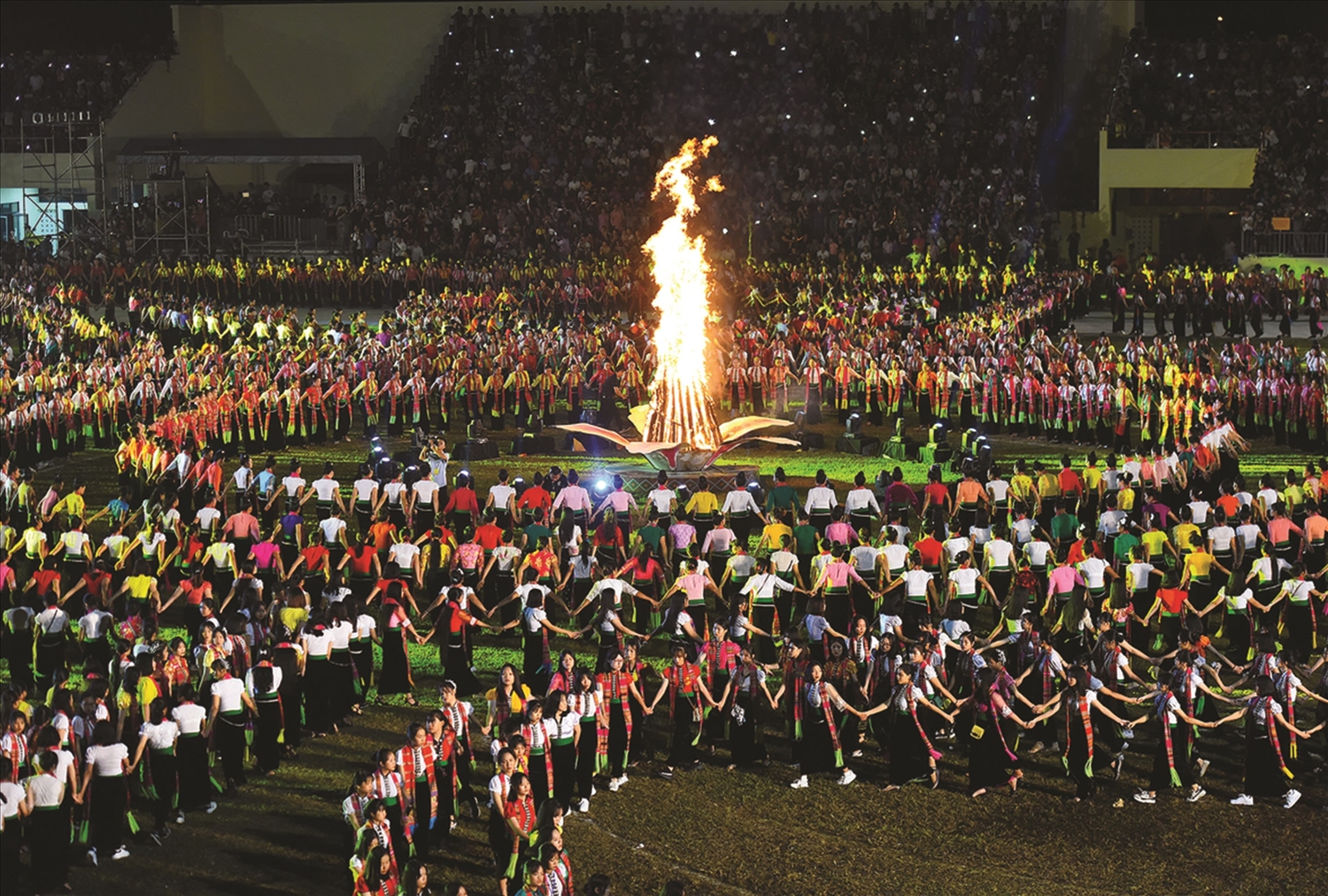
 The Art of Thai dancing - Representative Intangible Cultural Heritage of humanity
Keywords: Cultural values; Ethnic minority; National Defense; Security; Border region; The strategic alignment of the people’s hearts; Great national unity.
1. Introduction
Vietnam is home to 54 ethnic groups, with 53 ethnic minority groups accounting for 14.1% of the population. The rich cultural value systems of these ethnic minority communities not only foster patriotism and enrich the nation’s overall culture but also serve as a core political and spiritual foundation for the cause of national defense.
In recent times, the guidelines and policies of the Party and the State, most notably the National Target Programs along with the active participation of various levels of government, sectors, and the armed forces (particularly the Border Guard), have brought about comprehensive improvements to the lives of the people. These initiatives have effectively integrated the preservation and promotion of traditional cultural values with socio-economic development, while simultaneously strengthening national defense and security in border regions. However, under the influence of globalization, digital transformation, and a market economy, many traditional cultural values are at risk of fading away. Notably, hostile forces consistently exploit ethnic and religious issues to incite unrest and sow division within the great national unity, particularly in strategically significant areas. Given this context, a new mindset is required: promoting the cultural values of ethnic minority groups should go beyond mere heritage preservation; it must be elevated into a strategic solution for building a “solid foundation of public support” strengthening internal resilience and firmly consolidating the all-people national defense in the new era.
2. Cultural values of ethnic minority groups and their role in building and strengthening national defense and security in Vietnam’s border regions today
2.1. The cultural values of ethnic minorities contribute to strengthening the great national unity - the foundation for the all-people national defense and the “posture of the people’s hearts”
According to a report by the Ministry of Culture, Sports and Tourism, by 2025, nearly 40 cultural heritage sites across the country had been recognized by UNESCO. Many of these belong to ethnic minority communities, including the Space of Gong Culture in the Central Highlands, the dancing of the Thai people, and the pottery-making art of the Cham people. The UNESCO recognition of such heritage including the Space of Gong Culture in the Central Highlands and the Xòe dance of the Thai people serves as a vivid testament to the sound policy of national unity upheld by the Party and the State, instilling great pride in the Vietnamese nation. This stands as irrefutable evidence that refutes the slanderous claims made by hostile forces, who falsely accuse Vietnam of “cultural assimilation” or the “oppression of ethnic groups”.
Thus, the cultural values of ethnic minority groups in border regions extend beyond mere spiritual significance; they hold strategic importance within the framework of the all-people national defense system.
2.2. Cultural values contribute to raising awareness about the protection of territorial sovereignty and national border security, while thwarting attempts to exploit ethnic, religious and cultural issues to undermine our Party and State
For ethnic minority communities, the border is not merely an administrative demarcation line but a space for survival, deeply intertwined with their history and collective identity. Based on this, various models involving the public in border protection have been established and proven effective such as “Self-managed groups for border lines and markers,” “Self-managing clans” and “Peaceful villages”, all of which continue to yield positive, practical results. According to a report by the Border Guard Party Committee, the Border Guard force has collaborated with the Party committees and local authorities of 553 border communes across 30 provinces and cities to establish and maintain 2,702 self-management groups. These groups have engaged 45,638 households and 114,276 individuals who have voluntarily registered to help manage and protect approximately 4,702.164 kilometers of border and 3,613 national border markers.
These telling figures serve as compelling proof of the power of culture when channeled in the right direction transforming every citizen into a “living landmark” and forging a steadfast, people-based shield that firmly protects the sacred sovereignty of the Fatherland.
2.3. Cultural values serve as a driving force for socio-economic development, thereby strengthening national defense and security capabilities
In Vietnam, the transformation of heritage into an economic asset has emerged as a strategic lever for development in the nation’s border regions. Localities such as Sa Pa (Lao Cai province), the Dong Van Karst Plateau (Tuyen Quang province), Kon Tum and An Giang provinces have effectively harnessed traditional cultural values to foster community-based tourism and promote local craft products. This has helped raise the average annual per capita income in many border-based cultural tourism villages to between 50 and 70 million VND, with some households even reaching annual revenues of 200-300 million VND. As economic conditions stabilize, the phenomenon of spontaneous migration has declined; local residents now feel secure in remaining on their ancestral lands, voluntarily collaborating with armed forces to build a robust “people’s defense posture”. In doing so, they have transformed each cultural village into a steadfast bastion safeguarding national sovereignty along the borders while establishing a stable social foundation.
3. The current state of promoting the cultural values of ethnic minority groups and its contribution to building and strengthening national defense and security in Vietnam’s border regions
3.1. Results achieved
Firstly, there has been a marked improvement in the awareness of the role that culture plays in the development and defense of the nation. The institutionalization of the Party’s perspectives on cultural development has fostered a positive shift in the understanding held by Party committees, local authorities and the people living in border regions. Many localities have identified the preservation and promotion of ethnic cultural identity as a key component of their strategies for sustainable development and the construction of defensive zones. A notable example is the former Ha Giang province, which issued Resolution No. 15-NQ/TU on October 6th, 2021, concerning the preservation and promotion of Ha Giang’s cultural heritage for the period of 2021-2025. In this resolution, former Ha Giang province explicitly linked the preservation of cultural identity with the development of a sustainable border defense zone. Members of the Lo Lo and Mong ethnic groups in the former Dong Van and Meo Vac districts have collaborated with the Border Guard forces to organize classes for the younger generation, teaching them traditional scripts and handicrafts right within their border-area villages.
In former Kon Tum province, the Gia-rai and Bana ethnic communities have skillfully integrated the responsibility of safeguarding border markers and the borderline into their village regulations and customary laws effectively transforming ancestral traditions regarding land stewardship into a potent instrument for protecting border security. Such voluntary actions serve as compelling proof that culture has truly evolved into political awareness, establishing a solid spiritual foundation along the nation’s frontier.
Secondly, the system of cultural institutions and the cultural environment in border regions have been gradually strengthened. Through national target programs and development projects for ethnic minority and mountainous areas, significant investment has been directed toward the construction of grassroots cultural facilities, fostering an environment conducive to the development of cultural, artistic and recreational activities for the public. By the end of 2025, over 90% of communes in ethnic minority areas will have established cultural centers or community gathering spaces, enabling local residents to organize activities dedicated to preserving traditional culture. The movement “All People Unite to Build a Cultural Life” continues to be implemented extensively, contributing to the preservation of traditional moral values, the gradual elimination of outdated customs and practices, and the cultivation of a wholesome cultural environment in border regions.
Thirdly, many traditional cultural values have been preserved and promoted in connection with socio-economic development. According to the summary report on the National Target Program 1719 for the period of 2021-2025, the implementation of Project 6 - a component of this program has led to the restoration of over 120 traditional festivals, the documentation of more than 2,500 folk songs and dances, and the establishment of over 700 cultural clubs in ethnic minority regions. These initiatives have been integrated with tourism development, the standardization of more than 1,200 OCOP (One Commune, One Product) items and the creation of jobs for over 25,000 workers, thereby contributing to increased incomes and sustainable poverty reduction.
A prime example can be found in Lao Cai province, where an eco-tourism model integrating the indigenous knowledge of the Red Dao people in Ta Phin village (Sa Pa) both preserves traditional herbal medicine practices and generates stable employment. In the strategic Central Highlands region, the Kon Ko Tu community-based tourism village (former Kon Tum province) and Buon Ako Dhong (Dak Lak province) stand out as notable success stories; here, the cultural space of the gongs and the traditional longhouses are actively promoted, serving as “cultural strongholds” that firmly bind the community together…
3.2. Limitations and their causes
About limitations: The first limitation is the significant risk that traditional culture may fade away. Under the influence of globalization and digital technology, some young people are increasingly moving away from using their native language and showing less interest in local heritage. Many festivals have become commercialized, while traditional folk art forms lack a new generation to carry them forward.
A second limitation is that resources and infrastructure fall short of practical requirements. In ethnic minority and mountainous regions, income levels are only one-third of the national average, and these areas account for over 50% of households living in multidimensional poverty, a situation that prevents residents from fully dedicating themselves to heritage preservation. Furthermore, 20% to 30% of border villages lack a standard-compliant community cultural center. The digitization of heritage has reached only 20%-25% of its target, as available funding covers just 40% of the actual need, and data systems across different sectors remain poorly integrated.
A third limitation is the weak connection between culture and national defense and security. In many places, the focus remains on superficial cultural displays, failing to integrate culture into traditional education, the strengthening of sovereignty awareness or the countering of erroneous narratives. Interdisciplinary coordination lacks depth.
About the causes: Objective factors include the challenging natural, economic and social conditions in regions inhabited by ethnic minority groups and in mountainous areas; furthermore, the processes of globalization and digital transformation present both opportunities and significant challenges for cultural preservation efforts. Subjective reasons: awareness of some party committees and authorities about the role of culture in building national defense and security is incomplete; The concretization of the Party’s policies is still lacking in synchronization; Investment resources and quality of staff do not meet requirements; Traditional propaganda and education for the younger generation has not kept up with the development of digital media.
4. Some solutions for promoting the cultural values of ethnic minorities to contribute to building and strengthening national defense and security in Vietnam’s border regions today
4.1. Raising awareness of the role of cultural values of ethnic minorities in the task of building and protecting the Fatherland
This is a foundational solution that determines the effectiveness of all other measures. On January 7th, 2026, the Politburo issued Resolution No. 80-NQ/TW regarding the development of Vietnamese culture. The Resolution states: “Promote the foundational role of culture in shaping character and building ‘resilience’ against the complex and deviant influences of foreign cultures; preserve fine customs and traditions; and cultivate a sense of pride and an aspiration to contribute to the nation’s development”.
In that spirit, party committees, party organizations, authorities, the Fatherland Front and socio-political organizations at all levels need to continue to deeply grasp the Party’s viewpoint on building and developing culture associated with socio-economic development, strengthening national defense, security and foreign affairs; Consider promoting the cultural values of ethnic minorities as an important content in the strategy for sustainable development of border areas. From viewing ethnic minority culture as a passive object that needs to be preserved to seeing culture as an endogenous resource that constitutes the border defense system.
4.2. Refining mechanisms and policies, and enhancing the effectiveness of state management regarding the preservation and promotion of cultural values, in connection with the strengthening of national defense and security
It is necessary to continue refining the policy framework to ensure alignment between cultural and ethnic policies and those concerning national defense and security; furthermore, the objectives of preserving and promoting cultural values should be integrated into the socio-economic development plans and strategies of border localities. In addition, priority should be given to investing in the development of grassroots cultural infrastructure, while also focusing on the preservation of the languages, scripts, festivals, folk arts, traditional crafts and indigenous knowledge of ethnic minority groups. At the same time, appropriate mechanisms should be established to leverage the roles of artisans, village elders, village heads and other influential individuals in teaching, safeguarding and promoting traditional cultural values, thereby contributing to the creation of a solid political and spiritual foundation at the local level.
4.3. Integrate the preservation and promotion of cultural values with socio-economic development, improving the lives of ethnic minorities
Experience has shown that cultural preservation is only truly sustainable when it is closely linked to improving the material and spiritual well-being of the people. Therefore, it is essential to continue the effective implementation of National Target Programs, with a priority on investing in infrastructure, education, healthcare, digital transformation, and sustainable poverty reduction. Recent practical evidence demonstrates that many forms of heritage have been transformed into sustainable livelihoods through iconic 4-to-5-star OCOP (One Commune, One Product) offerings, such as ancient-tree black tea from Phin Ho (former Ha Giang province), brocade textiles from Chieng Chau (former Hoa Binh province), coffee from Ea Tu (Dak Lak province) and Cham silk from Chau Phong (An Giang province).
Elevating the status of distinctive local agricultural products and community-based tourism not only creates sustainable livelihoods for the people but also transforms heritage into economic assets. This process must be developed harmoniously, avoiding over-commercialization to ensure that traditional identities remain intact. As prosperity grows, the people’s trust in the Party and the State is strengthened, establishing a solid foundation for social security that effectively supports national defense and security along the nation’s borders. In this context, culture becomes a vital driving force for sustainable development and the construction of a robust “people’s hearts and minds” defense posture.
4.4. Building a healthy cultural environment and promoting the strength of the great national unity as well as the role of the community and the armed forces in protecting the nation's borders
It is essential to continue leveraging the roles of village elders, village chiefs, influential individuals, religious dignitaries and folk artisans in disseminating and advocating for the implementation of the Party’s guidelines and the State’s policies and laws. These figures play a vital part in fostering community solidarity, resolving conflicts at the grassroots level, and participating in the protection of national border sovereignty. Currently, there are approximately 29,626 influential individuals among ethnic minority communities nationwide; they serve as a core force in promoting the Party’s guidelines, facilitating grassroots-level mediation and mobilizing the public to take part in safeguarding the nation’s borders.
The armed forces continue to play a core role in building an all-people border defense posture and a people’s security posture. They work closely with local party committees and authorities to organize cultural activities, promote traditional values, disseminate legal knowledge, support socio-economic development, and improve the well-being of the local population. At the same time, they continue to replicate effective initiatives such as “Self-managed Groups for Border Lines and Markers”, “Adopted Children of Border Guard Stations,” “Helping Children Stay in School,” and “Accompanying Women in Border Areas”, thereby strengthening the bond between the military and the people and building a solid “foundation of public support” in border regions.
4.5 Accelerating digital transformation, enhancing the quality of human resources and expanding cultural outreach
Digital transformation needs to be identified as an important solution to improve the effectiveness of preserving and promoting the cultural values of ethnic minorities. It is necessary to build a digital database on cultural heritage; promote the digitization of languages, scripts, folk arts, epics, festivals and indigenous knowledge; develop digital museums, digital libraries and online cultural education platforms. At the same time, build quality digital media products to promote the image of border areas, spread traditional cultural values and improve the ability to identify and fight against false and distorted information in cyberspace.
In parallel, it is essential to strengthen cultural diplomacy, expand people-to-people exchanges, foster “sisterhood” between residential communities on both sides of the border, and cooperate in preserving traditional cultural values, all while respecting the national sovereignty and laws of each country. Such people-to-people interaction and collaborative heritage preservation, grounded in respect for national sovereignty, will transform cultural values into a bridge of friendship. This, in turn, will establish a “green security belt” capable of preemptively curbing cross-border crime and thwarting attempts by hostile forces to incite conflict…
5. Conclusion
Promoting the cultural values of ethnic minorities is both an objective requirement for building an advanced culture deeply imbued with national identity and a strategic task in the cause of national defense. Moving forward, it is essential to refine institutional frameworks, enhance the effectiveness of state management, increase resource investment and accelerate digital transformation in the preservation of heritage. At the same time, it is essential to leverage the role of local communities, influential individuals and the armed forces in building a cultural life that is intrinsically linked to the protection of border sovereignty. In particular, cultural preservation must be closely integrated with socio-economic development, national defense, security and foreign affairs, transforming culture into an endogenous resource and a form of national soft power. This serves as the core foundation for firmly building the great national unity, strengthening the “posture of the people’s hearts” and establishing a solid political and spiritual anchor to firmly defend the Socialist Republic of Vietnam in the new period.
* Logistics Academy - Ministry of National Defence
References
1. Central Committee of the Communist Party of Vietnam (2014), Resolution No. 33-NQ/TW dated June 9th, 2014, on the development of Vietnamese culture and people to meet the requirements for the country’s sustainable development.
2. Politburo (2026), Resolution No. 80-NQ/TW dated January 7th, 2026, on the development of Vietnamese culture.
3. The Party Central Committee (2026), Documents of the 14th National Party Congress, National Political Publishing House, Hanoi.
4. Government, Report on the Implementation Results of the National Target Program for Socio-Economic Development in Ethnic Minority and Mountainous Areas (2021-2030), Phase I: 2021-2025 (2024).
5. Government of Vietnam. (2026). Decree No. 307/2026/ND-CP, dated August 4th, 2026, of the Government, regarding the selection, recognition, and policies for influential individuals within ethnic minority communities. Portal of the Ministry of Ethnic and Religious Affairs. https://vanban.chinhphu. vn/?pageid=27160&docid=219081 [1, 2]
6. Committee for Ethnic Minority Affairs, Report on the Results of Ethnic Minority-Related Work in 2024 and Key Tasks for 2025.
7. National Assembly Portal: “Grassroots-level mediation: The law should include provisions to leverage the role of political organizations”. Accessed on August 10th, 2026. https:// quochoi.vn/tintuc/Pages/tin-hoat-dong-cua-quoc hoi.aspx?ItemID=100960
8. Vietnam Border Guard. (2024). Coordination regulations contribute to firmly safeguarding territorial sovereignty and national border security. Bien Phong Online Newspaper. bienphong.com.vn
