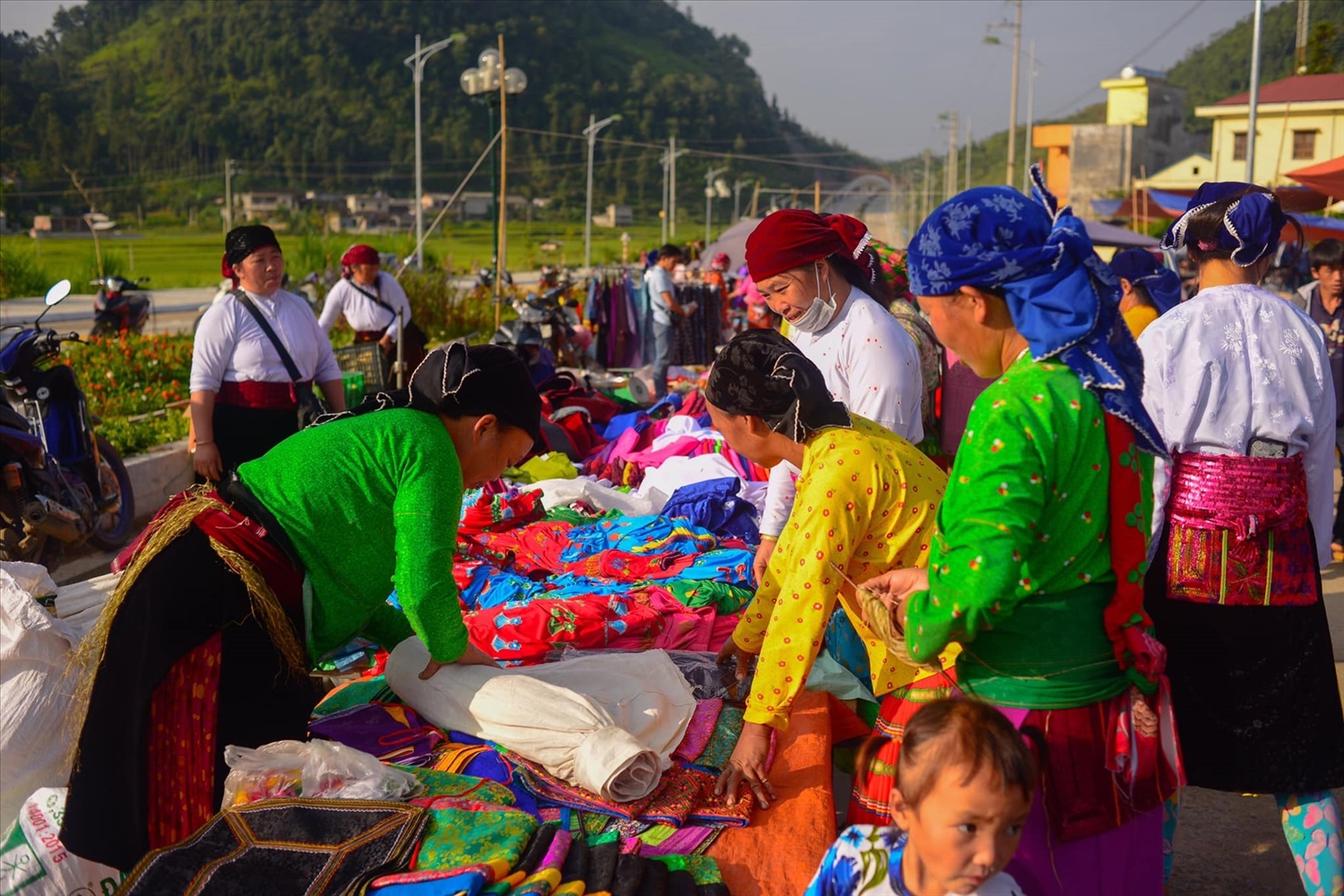
 The Mong market at the foot of the Lung Cu flagpole
Keywords: Cultural values; Economic development; Sustainable livelihoods; Land border region; Community tourism.
1. Introduction
Vietnam’s land border region is the long-standing home of many ethnic minority communities, characterized by complex terrain, limited infrastructure and traditional livelihoods primarily based on small-scale agriculture. In this context, promoting ethnic cultural values as an economic resource through community tourism, handicrafts, cultural services and forms of local knowledge-based economy is increasingly becoming an important direction for improving livelihoods.
In practice, culture has long been used by border communities as a form of “livelihood capital”, manifested in the way they organize production, divide labor, pass on skills and maintain social networks. Recently, under the influence of development policies and market demands, many cultural values continue to be restructured and transformed into new economic activities, most notably the community-based tourism model associated with traditional residential spaces, local architecture and distinctive cultural practices. However, the extent and effectiveness of this process vary among communities, depending on local conditions and internal organizational capacity.
This article focuses on analyzing two cases in Lung Cu commune: the Hmong community in Then Pa village and the Black Lo Lo community in Lo Lo Chai village. Despite living in the same border area, these two communities have different ways of promoting their cultural values in economic development. The comparison of the two cases aims to clarify the role of ethnic culture as an economic resource, while also contributing to providing a practical basis for building culturally-based development models suitable to the specific characteristics of each border community.
2. Research results
2.1. From cultural capital to livelihoods: A cultural analysis framework in community economic development
For Vietnam’s land border regions, where natural conditions are harsh, livelihood opportunities are limited, and the potential for capital accumulation is low, ethnic culture is often one of the sustainable and highly viable resources for economic development. In this context, the Mong and black Lo Lo communities in Lung Cu commune are two typical examples of mobilizing ethnic culture as a resource for development. Bourdieu’s theoretical framework of cultural capital allows for the analysis of how cultural values are transformed into economic benefits through specific social practices. According to Bourdieu (1986), cultural capital exists in embodied, objectified and institutionalized forms. For the Mong and black Lo Lo people, embodied cultural capital is manifested in knowledge of farming on rocky mountains, handicraft skills and the ability to organize family and community life; Objectified capital is associated with traditional housing architecture, clothing, production tools and handicrafts. While institutionalized capital is manifested through recognition by development programs, tourism village designations, or community-based tourism management institutions. The combination of these forms of capital creates a foundation for culture to participate in new economic activities.
However, the cultural capital of the Mong and black Lo Lo people does not automatically generate economic value. The transformation of culture into livelihoods only occurs when suitable spaces are available, especially community tourism and cultural experience services. As Li (2007) points out, this process is always associated with power relations, in which the selection of which cultural elements to introduce into the market and who the beneficiaries are plays a decisive role. In fact, differences in community organization, levels of initiative, and resource control have led to different development outcomes between the Mong and the Black Lolo people, despite living in the same border area.
From a sustainable livelihood perspective, the cultures of the Mong and black Lo Lo people not only generate direct income through tourism, homestay and handicraft production, but also contribute to strengthening trust, prestige and social networks necessary for economic exchange. However, anthropological studies also warn of the risks of standardization and commercialization of culture when it is detached from its original social context. Therefore, culture only truly becomes a resource for development when the Mong and black Lo Lo communities play a central role in selecting, organizing and regulating economic activities based on their own cultural values.
2.2. Research area and approach
Lung Cu commune, Tuyen Quang province, is a border commune adjacent to China, where the natural conditions are harsh and the terrain is rugged and rocky. In 2024, the commune had 1,048 households with 5,416 inhabitants; The Mong are the majority ethnic group, followed by the Lo Lo, the Kinh and several other ethnic groups. The poverty rate according to the multidimensional poverty standard is still 19.94%, reflecting a low but improving standard of living.
Within the Lung Cu commune, the research selected two representative villages: Then Pa, inhabited by the Mong ethnic group and Lo Lo Chai, inhabited by the black Lo Lo ethnic group. Then Pa, located in the center of the commune at the foot of Dragon Mountain, is an area heavily impacted by resettlement processes linked to tourism development. These changes alter the living spaces and livelihoods of the Mong people, while also necessitating a restructuring of traditional cultural practices such as rammed earth houses, community organization and local knowledge. Meanwhile, Lo Lo Chai, the long-standing home of the black Lo Lo people, is now prominent for its community-based tourism model that leverages the cultural values of the ethnic group. In 2024, homestay and tourism services generated over 4 billion VND in revenue, contributing to a reduction in the number of poor households to only 4 out of 120.
In terms of research methodology, the research applies the theoretical framework of cultural capital to analyze how the Mong and black Lo Lo communities transform cultural values including local knowledge, skills, customs, architecture, language and social networks into resources for economic development.
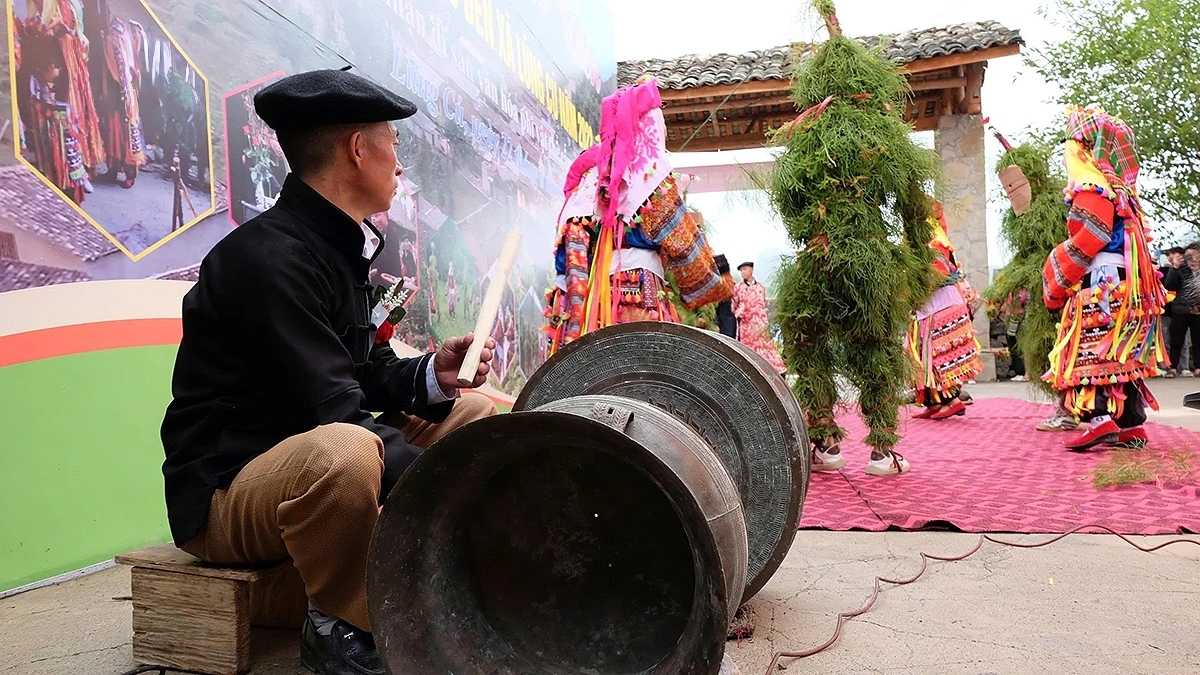 Playing bronze drums at the Ancestor Worship Ceremony of the black Lo Lo people in Lung Cu commune
3. The role of ethnic culture in economic development among the Mong and black Lo Lo communities
The survey results show that the percentage of people in Lung Cu commune participating in exploiting natural attractions, historical and cultural relics, and landscapes for economic development is very high: 93.8% for the Mong people and 75% for the Black Lo Lo people; Of these, the participation rate in exploiting tourism at scenic spots and historical sites ranges from 87% to 95%. However, behind those seemingly similar figures lie very different approaches to transforming culture into economic resources between the two communities. This difference reflects not only economic conditions or levels of market access, but more importantly, the way their cultural values are integrated into their daily economic lives.
3.1. The black Lo Lo people of Lo Lo Chai village: Organizing culture into a concentrated local economic resource
The black Lo Lo people in Lo Lo Chai village are the group that best demonstrates their ability to organize their ethnic cultural values into a relatively complete livelihood system linked to community tourism. This is evident first and foremost in the transformation of traditional housing spaces.
According to the survey results, 51.9% of the black Lo Lo people use their homes for tourism purposes, the highest rate among the ethnic groups studied. Traditional rammed earth houses, which are closely linked to the local settlement history and construction techniques, have been modified to become homestays, preserving the traditional architectural style while meeting the accommodation needs of tourists. In the village, there are 52 households operating homestays, mostly traditional earthen-walled houses but with renovated interiors that are more beautiful and convenient for tourists. For many families, investing in homestays is seen as a long-term livelihood strategy. Notably, the exploitation of cultural values in housing is not limited to households with capital; for more disadvantaged households, culture is still transformed into economic resources through flexible forms of collaboration.
Besides their living spaces, traditional cuisine is also an important cultural resource exploited by the black Lo Lo people. The people in Lung Cu commune have learned to commercialize their traditional dishes; Among them, the black Lo Lo people stand out for directly integrating their cuisine into tourism services. Besides providing on-site dining, many households also produce products such as dried meat, sausages, and dried buffalo meat to sell to tourists as souvenirs, thereby extending the cultural and economic value chain beyond the homestay area.
Traditional clothing is another cultural resource effectively utilized by the black Lo Lo people. Questionnaire data shows that 27.3% of black Lo Lo people use their clothing for business purposes and 40.3% use it for tourism, the highest rates among the surveyed groups. It can be seen that, for the black Lo Lo people, tangible and intangible cultural values have been interconnected into a relatively concentrated livelihood system, in which community tourism plays a central role.
3.2. The Mong people in Then Pa village: exploiting their culture in a dispersed manner and linked to the weekly market
Compared to the black Lo Lo people, the Mong community in Then Pa village has a distinctly different approach to cultural exploitation. Despite sharing the same natural landscape and living near important historical sites, the Mong are less likely to convert their residential spaces into tourist areas. The survey results show that the houses of the Mong people are mainly used for storing agricultural products and production materials (34.7%), while the rate of using houses for tourism is significantly lower than that of the black Lolo people.
Instead of focusing on accommodation tourism, the Mong people exploit their cultural values primarily through the institution of the weekly market - a traditional cultural and economic space. This shows that the weekly market plays a central role in organizing the livelihoods of the Mong community. Instead of focusing on accommodation tourism, the Mong people exploit their cultural values primarily through the institution of the weekly market - a traditional cultural and economic space. This shows that the weekly market plays a central role in organizing the livelihoods of the Mong community. At the Lung Cu market, the Mong people sell a variety of food products such as stone cakes, grilled sticky rice cakes, sausages and grilled skewers. In addition, corn wine, herbal wine, vegetables, livestock and other homemade products are also brought to the market, creating a steady source of income linked to the market’s rhythm rather than relying on a fixed flow of tourists.
The traditional clothing of the Mong people is also being utilized in a flexible and mobile manner. This shows that the Mong people are transforming their clothing culture into a livelihood through a network of highland markets, rather than being closely tied to community tourism destinations.
In the tourism sector, only a small number of Mong people in the Then Pa community tourism village participate in hosting tourists, while the majority are visitors.
4. Cultural capital and transformation mechanisms in the economic development of communities in land border regions
Research results in Lung Cu commune show that ethnic culture actually operates as a form of capital, but does not follow a single path of transformation. From Bourdieu’s (1986) perspective, black Lo Lo and Mong communities both possess embodied cultural capital through local knowledge, craft skills, living practices and value systems passed down through generations. However, the key difference lies in the ability to transform this embodied cultural capital into other forms of capital, particularly economic capital, through specific social and market spaces.
The case of the black Lo Lo people demonstrates a relatively direct and concentrated transformation mechanism. Cultural capital is clearly objectified through their rammed earth house architecture, traditional clothing, and cuisine, and then integrated into a highly organized community-based tourism model. This process allows culture to be “packaged” into specific products and services, creating a stable income stream for many households.
Conversely, the Mong people in Lung Cu commune exhibit a decentralized transformation mechanism linked to traditional institutions. Cultural capital is primarily mobilized through the market, a historically significant socio-economic space where culinary practices, clothing and handicrafts are commercialized according to community life rather than the logic of the tourism market. This approach generates a steady but small-scale income, at the same time keeping cultural practices from becoming standardized or detached from their existing social context.
In Lung Cu commune, the black Lo Lo people and the Mong are following different paths, reflecting the diversity of mechanisms by which cultural capital operates in the economic development of the border region. This suggests that development policies should avoid a uniform approach, instead identifying and supporting forms of cultural capital transformation that are appropriate to the social structure and cultural practices of each specific community.
5. Conclusin
This research shows that promoting the cultural values of ethnic groups in economic development in Vietnam’s land border regions is not a spontaneous or uniform process, but rather the result of different mechanisms for transforming cultural capital, linked to the historical conditions, social structure and organizational capacity of each community. Through the case researchs of the black Lo Lo and Mong people in Lung Cu commune, this article clarifies how cultural practices from architecture, clothing and cuisine to local knowledge and community living spaces are mobilized as unique forms of capital, directly participating in livelihood activities and generating income for the people.
From the perspective of cultural capital theory, the research results confirm that culture only truly becomes an economic resource when there are suitable social spaces for its transformation. In Lung Cu commune, the black Lo Lo people have transformed their embodied cultural capital into economic capital through a highly organized community-based tourism model, allowing their culture to be objectified and linked to the tourism market. Meanwhile, the Mong utilize their cultural capital in a more dispersed manner, primarily through markets and traditional forms of exchange, creating small-scale livelihoods.
These two paths reflect the diversity in how communities define and practice culturally-based economic development.
* Institute of Ethnology and Religious Studies
References
1. Appadurai, A. (2013). The Future as Cultural Fact: Essays on the Global Condition. Verso Books.
2. Bourdieu, P. (1986). The forms of capital. In J. Richardson (Ed.), Handbook of theory and research for the sociology of education (p.241-258). Greenwood Press.
3. Chambers, R., & Conway, G. R. (1992). Sustainable rural livelihoods: Practical concepts for the 21st century (IDS Discussion Paper No. 296). Institute of Development Studies.
4. Comaroff, J., & Comaroff, J. L. (2009). Ethnicity, Inc. University of Chicago Press.
5. Li, T. M. (2007). The Will to Improve: Governmentality, Development, and the Practice of Politics. Duke University Press.
6. Scoones, I. (1998). Sustainable rural livelihoods: A framework for analysis (IDS Working Paper No. 72). Institute of Development Studies.
7. Sen, A. (1999). Development as Freedom. Alfred A. Knopf.
8. Lung Cu a Commune People’s Committee (2024), Report on the results of implementing socio-economic development tasks and ensuring national defense and security in 2024; Directions and tasks for 2025, Report No. 252/BC-UBND dated December 20th, 2024.
9. People’s Committee of Lung Cu commune (2024), Results of the review of poor households at the commune/ward level at the end of 2024.
