Keywords: Mother Goddess; The mother; Symbol; Vietnam.
1. The Mother with the power of ownership
Over time, the system of deities worshipped at the Mother Goddess temple has been perfected with a fairly diverse and rich array of deities. The Mother Goddess shrine comprises several different sections with male and female figures arranged side-by-side: Jade Emperor, Three Holy Mothers, Five Royal Officials, Four Royal Ladies, Five Princes, Ten Royal Princesses, Ten Royal Young Men, Five Tigers, Mr Lot.
The Jade Emperor is the highest deity in the Mother Goddess worship tradition, a fact heavily influenced by Taoism. In terms of form, the Jade Emperor holds the highest position, with his own altar in temples and shrines, but “the role of the Jade Emperor in rituals and worship, in the folk consciousness is very vague”, and in many places of worship dedicated to the Mother Goddess, there is even no altar for the Jade Emperor. All supreme power is concentrated in the Mother, who is the sole creator of the universe, yet she manifests herself as the Holy Mothers who govern different realms (the Three Realms and the Four Realms). Below the Three Holy Mothers are the Five Royal Officials: high-ranking officials who, under the command of the Holy Mothers, govern the Four Realms and the Four Goddesses: the Saints, acting in place of the Blessed Mother governing throughout the four directions…
The appearance of Saint Mother Lieu Hanh as the highest deity, Mother of the World elevated the worship of the Mother Goddess to a new level, representing a transformation from celestial to human deity, capable of transforming one’s essence into celestial beings, this is interpreted as humanity’s aspiration and dream of mastery, of humans conquering and controlling nature...
In examining the dominant power of the Mother Goddess in the Mother Goddess worship tradition within the context of Vietnamese society, although the role of men has been elevated, the role of women has not been disregarded. From a societal perspective, the man is the head of the family, but the wife and mother still hold a crucial role in the family; in fact, the true power in the family still rests with the mother and wife: “The husband’s command is not as strong as the wife’s” “Wife comes first, then God”. With the traditional division of labor, where men work outside the home and women work inside, no matter how successful a man is in society, when he returns home, the role of “housewife” is relinquished to the wife and mother in the family. The role of a mother in her children is especially important: the love and sacrifice of both father and mother are immeasurable: “A father’s love is like Mountain Thai Sơn/A mother’s love is like the water flowing from a spring”.
2. The Mother with the power of procreation and creation
“Mother”: In the context of fertility, “Mother” refers to the continuous growth and development of all things, not simply to the reproduction of humankind. Because of its original meaning, the custom of worshipping the Mother Goddess originated from a psychological and conscious desire to emphasize the elements of birth, nurturing and upbringing.
Regarding the generative and creative power of the Mother, author Vu Ngoc Khanh addresses this in his work: “A mother creates her child, and cares for her child from the day the child is in the cradle until the day she passes away. In the early days of human history, people only knew of mothers, not fathers. The formation of a society also had to go through an initial stage: the Matriarchal period. Therefore, in the human conception, the image of the mother is indispensable”.
In the article “Maternalism in Vietnamese Culture” by Tran Van Doan, in the concluding section, the author offers his comments: Firstly, Vietnamese thinking focuses on the birth element. In other words, it is a way of thinking based on the characteristics of the mother. The word “mother” primarily symbolizes procreation. That is why all the most important things, people, or deities share a common function: the function of reproduction. That is why Vietnamese people often use the words mother, mau, bu to refer to all the elements that contribute to reproduction. The ability to procreate and innovate becomes a crucial attribute that demonstrates the unique power of the mother.
For Vietnamese people in general, children are very important; getting married and building a family is only considered complete when there are enough children. A woman’s value lies in her ability to be a mother; folk songs, proverbs and idioms say, “A poisonous tree bears no fruit, a wicked woman bears no children”. In the system of temples dedicated to the Mother Goddess in Vietnam, there are many places famous for their “function” of “asking for children”. At Sinh Temple in Hai Phong city, there is an open-air rock formation shaped like a woman giving birth, respectfully known as the Holy Mother Stone Tablet. Many people come to the temple with the intention of “praying for children”; and when their prayers are answered, they must return to offer thanks. The Three Goddesses of Childbirth and the Twelve Midwives, with their power to oversee childbirth, are worshipped in many places, especially in the southern regions of Vietnam. In Da Nang city, the Fujian Assembly Hall is a place of worship for the Chinese Mother Goddess: Mother, in its simplest understanding, means the one who gave birth to each of us; representing the protection and care for humanity and all things. The worship of the Mother Goddess involves venerating all beings with a “female” element and the ability to reproduce. Behind the shrine dedicated to the Three Goddesses of Childbirth and the Twelve Midwives, the majority of those who come to pray are women, those without children wish to “give birth”, those who are pregnant pray for a safe delivery and those who have children pray for their children to “eat well, grow quickly”, to be “obedient, healthy, and easy to raise”,.... Similarly, at Ngoc Hoang Pagoda (Ho Chi Minh city), there is a shrine dedicated to Kim Hoa Thanh Mau and the Twelve Midwives, which is also a famous place for those seeking to have children.
Generally, when people come to worship the Mother Goddess, they all express their wishes related to fertility and creation, not just limited to having many children and grandchildren, but extending to harmony and prosperity in all things, abundant harvests and a comfortable and fulfilling life, as the Tay people worship the Moon Mother with the wish for favorable weather and a prosperous life.
3. Mother, with her power to protect, nurture and creating happiness
In the spiritual life of the Vietnamese people, the worship of the Mother Goddess appeared very early, initially as Mother Nature and later as Mothers of society, mythical and historical figures who were deified and revered. When speaking of a mother in the literal sense, it usually refers to two functions: childbirth and nurturing. Birth is about procreation and the continuation of the species. A mother endures the pain of pregnancy and childbirth, carrying a child for nine months and ten days, going through countless difficulties and hardships to bring a child into the world. After giving birth, the next step is “nurturing”, meaning raising, protecting and caring for one’s child, always wanting to provide the best and happiest things for them. A mother spends her entire life caring for, raising and creating happiness for her child. Therefore, a mother's contributions are incomparable: “Some say a mother’s love is like a mountain, but in reality, a mother’s love is even greater”. Legends about the Holy Mothers clearly demonstrate the protective and nurturing power of a Mother over the lives of her children (the people). And it is precisely because of these great contributions that the people remember their gratitude and erected temples to honor them. Regarding the Holy Mother Thoai Cung, “there are many different folk beliefs about Mother Thoai, many legends about the times she manifested herself to help the country and the people, especially during the Tran and Le dynasties, which were passed down in folklore and recorded in the imperial decrees of the ancient feudal court”. The second and third incarnations of Saint Mother Lieu Hanh manifested to help humanity, wholeheartedly dedicating herself to bringing peace and happiness to the people by bestowing blessings upon the virtuous and severely punishing the wicked, thus bringing justice to the people. Not only did Saint Mother Lieu Hanh help stabilize the lives of the people, but she also made great contributions to helping the king and the people fight the enemy, bringing peace and happiness to the people. The image of the Vietnamese woman also represents a woman of the homeland, with fervent patriotism and a willingness to sacrifice for her country. The pages of Vietnamese history, with images of the Trung Sisters, Lady Trieu and others riding elephants into battle to restore peace to the country have become symbols of patriotism and the strength of Vietnamese women.
One of the legends about the Holy Mother Thien Ya Na, passed down at the Poh Nagar tower in Khanh Hoa province, compiled by the Minister of Rites Phan Thanh Gian on May 5th, 1857 (translated by Quach Tan) mentioned the following detail: It was the Holy Mother Thien Y A Na who taught the people of Dai An region (Khanh Hoa province) about civilized life: farming, weaving, making yarn, establishing rituals,… so that the fields could be expanded and the people’s lives could become increasingly prosperous and fulfilling. She not only brought civilization to the Dai An region, but the people in neighboring areas also benefited. Out of gratitude for her virtuous deeds, when she passed away, the people of the region built a pagoda to worship her.
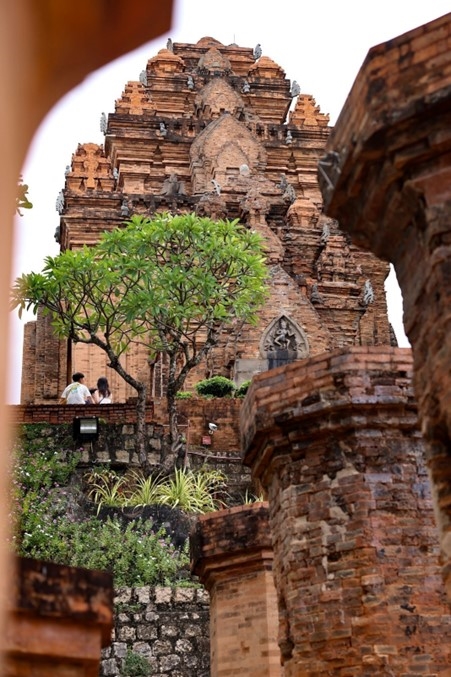 Po Nagar Tower in Khanh Hoa province is a place of worship for Saint Mother Thien Y A Na
One characteristic that distinguishes the worship of Mother Goddess from other beliefs and religions is that those who come to her usually do not pray for the future or the “afterlife”, but rather for the fulfillment of their immediate, daily needs. They pray for very practical, everyday needs: health, peace, wealth, fame, love,… Because of the belief that the Holy Mothers are mothers who are always wholeheartedly devoted to their children, caring for them in every way, ensuring they have enough to eat and a good night’s sleep, always creating conditions and sacrificing themselves so that their children can be as happy and prosperous as possible. Therefore, temples dedicated to the Mother Goddess always attract large numbers of people from all walks of life who come to pray for their wishes and desires to be fulfilled. During the New Year, holidays, and ancestral commemoration months such as March and August, temples and shrines dedicated to the Mother Goddess throughout the country are filled with the fragrant smoke of incense and bustling with people. On these occasions, many bronze statues are made to meet the religious needs of believers. There are famous temples and shrines that specialize in praying for a particular thing, such as the Lady of the Treasury Temple, which specializes in praying for wealth and prosperity in business and trade, through the practice of “borrowing at the beginning of the year and repaying - at the end of the year”. Legend has it that she was assigned the task of guarding the granary at Kho Mountain for the imperial court's resistance against the Tong army. Thanks to her intelligence, quick wit, and dynamism, she made a significant contribution to the resistance war. In remembrance of her contributions, a temple was erected in her honor and she is respectfully called Lady of the Treasury. Since then, every year, at the beginning of the year, people from all over, especially merchants, flock to "borrow capital" from the Goddess of the Treasury, hoping for a year of abundant capital, prosperous business and plenty of money; at the end of the year, they prepare offerings to express gratitude and repay the “capital” borrowed at the beginning of the year; The Bac Le communal temple (Lang Son province), dedicated to the Holy Mother Thuong Ngan is considered a famous temple for praying for love and marriage throughout Northern Vietnam and the entire country (Vietnam); Tay Ho Temple, a place of worship dedicated to Saint Mother Lieu Hanh, is famous for prayers for blessings, rituals and prosperity.
4. The Mother, with her power is a symbol of perfect beauty in form, soul and intellect
Throughout history, women have always been symbols of beauty, which is why women are also known as the fairer sex. Therefore, all the Holy Mothers worshipped in the tradition of Mother Goddess worship are depicted with the most beautiful images.
The Holy Mother of the Nine Heavens, who governs the celestial realm, appeared with a noble and radiant countenance:
“A beautiful face and delicate eyebrows
Imagine a graceful figure with a smile as beautiful as a flower
Slim waist, flowing hair
A fragrant, musk-scented shirt and floral shoes”.
The Holy Mother of the Mountains is also described in legends as a beautiful girl with many talents, who often traveled with her father through the mountains, forests and caves. The Holy Mother Lieu Hanh is praised for her beauty that could bring down kingdoms:
“The moon’s smile blossoms like flowers
The two-lobed pearl-like face resembles Hang Nga (Chang’e)
Pink dress with pearl and ivory hairpin
A slender waist and delicate, flowing hair make her even more attractive”.
Or in Doan Thi Diem’s version of Van Cat Than Nu, the Holy Mother Lieu Hanh, in her first incarnation under the name Giang Tien is described as a woman of extraordinary beauty: “When she grew up, her skin was as white as solidified wax, her hair as shiny as a mirror, her eyelashes curled like the rising moon and her eyes sparkled like autumn waves”. Vietnamese people value not only physical beauty but also inner beauty: “Good wood is better than good paint”, so the image of Saint Mother Lieu Hanh is perfectly beautiful, embodying the qualities of a woman who is virtuous, graceful, eloquent and morally upright. According to legend, when Giáng Tiên was still living with her parents, she was extremely filial, obedient, polite, and focused on her studies. Every day, she would spend alone at home reading, practicing calligraphy, mastering music and excelling at playing the flute and stringed instruments. When she married Dao Lang, she fulfilled her duties: showing respect and filial piety to her husband’s parents, observing proper etiquette and obedience to her husband “following the example of a virtuous woman in Quan Thu’s poetry”, and bearing many children. When she ascended to Heaven and was reborn a second time, she still fulfilled her filial duty to her parents, advising her husband to take her place in honoring them: “My parents are back in our hometown, and they have high expectations of you. You should visit them often on my behalf, morning and evening, and not forget your duty as a son-in-law”, she earnestly advised her husband to focus on self-improvement and managing the household. After that, she traveled the world, appearing and disappearing suddenly, transforming in unpredictable ways. When people brought offerings to pray to her, “All the money, silk and other gifts they offered were brought home for her parents to use”. Her kind and compassionate heart is truly precious! In her second marriage to Thu Sinh from the eastern part of Soc village, Nghe An (Thu Sinh was the reincarnation of the Fairy Princess), she also devoted herself to fulfilling her marital duties with "harmonious love and respect for each other”, shared everything like close friends, always advising her husband to focus on his studies and not to be distracted by frivolous pleasures. For example, when she saw her husband neglecting his reseachs because of his infatuation with women, she said: “As a “Confucian scholar”, learning must be accompanied by practice. Firstly, one may advance in life through literature and later, one must use one’s talents in governance to serve society. If one merely polishes each word, showing off their talent and stealing the empty prestige of Confucianism, then that is not worthy of respect”. The husband, feeling ashamed, apologized profusely: “This humble student was previously arrogant due to his meager talents and acted recklessly. Having heard these wise words, I will engrave them in my heart and will not dare to be as reckless as before”. From then on, he focused on his studies, passed the exam the following year and was appointed to the Academy.
The beauty of intellect is typically embodied in the image of Saint Mother Lieu Hanh. In ancient feudal society, women were often looked down upon due to the patriarchal ideology of “prioritizing men over women” and were considered inferior to men, especially in education and intellectual pursuits. The imperial examinations organized by the feudal court were usually open only to men. Therefore, the intelligence of women was rarely mentioned. But the image of Saint Mother Lieu Hanh is completely different. Saint Mother Lieu Hanh has become a symbol of intelligence and excellence. Her talent and intellect could rival that of the greatest scholars and physicians of her time. In the story of Van Cat Than Nu, there is a remark about the exchange between her and Trang Bung Phung Khac Khoan. Before his witty responses, Trang Bung Phung Khac Khoan exclaimed: “Where is she from, to possess such intelligence?” Then came the second reunion, a poetry contest, a classical poetry recitation at the romantic West Lake, where the three great and noble men, Phung Khac Khoan and his two friends Ngo and Ly family, all highly talented and knowledgeable individuals with excellent writing skills had to exclaim in praise: “Is she perhaps a goddess? How can she be so intelligent!”. Or consider the scholar who was her former husband, reborn as a human being, upon seeing her brushstrokes and poetic ideas, he was so impressed by her talent that he exclaimed: “With such consistent writing style and beautiful verses, never imagined there could be such a talented woman in this world! Even if “Di An” and “Thuc Chan” were to come back to life, it’s not certain who would be better or worse”.
5. Conclusion
The image of the Mother Goddess, as depicted in the Vietnamese tradition of worshipping the Mother Goddess is presented in a rich and diverse manner, creating a complete, beautiful and radiant symbol with the highest symbolic value. In the Mother Goddess worship tradition, the image of the Mother Goddess is manifested with special powers: the power of control; the power of procreation and creation; the power of protection, nurturing and creating happiness; as a symbol of perfect beauty,... It is these powerful attributes that create the radiant beauty and immortal vitality of the symbol of the Vietnamese Mother.
References
1. Tran Quang Dung (editor, 2017), The belief in worshipping the Four-Realm Mother Goddess in sacred places in the real world, The World Publishing House, Hanoi, p.27.
2. Vu Ngoc Khanh (2012), The custom of worshipping Saints and Mothers in Vietnam, Culture and Information Publishing House, Hanoi, p.11.
3. Phan Ngoc (2015), Vietnamese Cultural Identity, Culture and Information Publishing House, Hanoi.
4. Ngo Duc Thinh (editor, 2009), Mother Goddess Religion in Vietnam, volume 2, Religious Publishing House, Hanoi, p.32.
