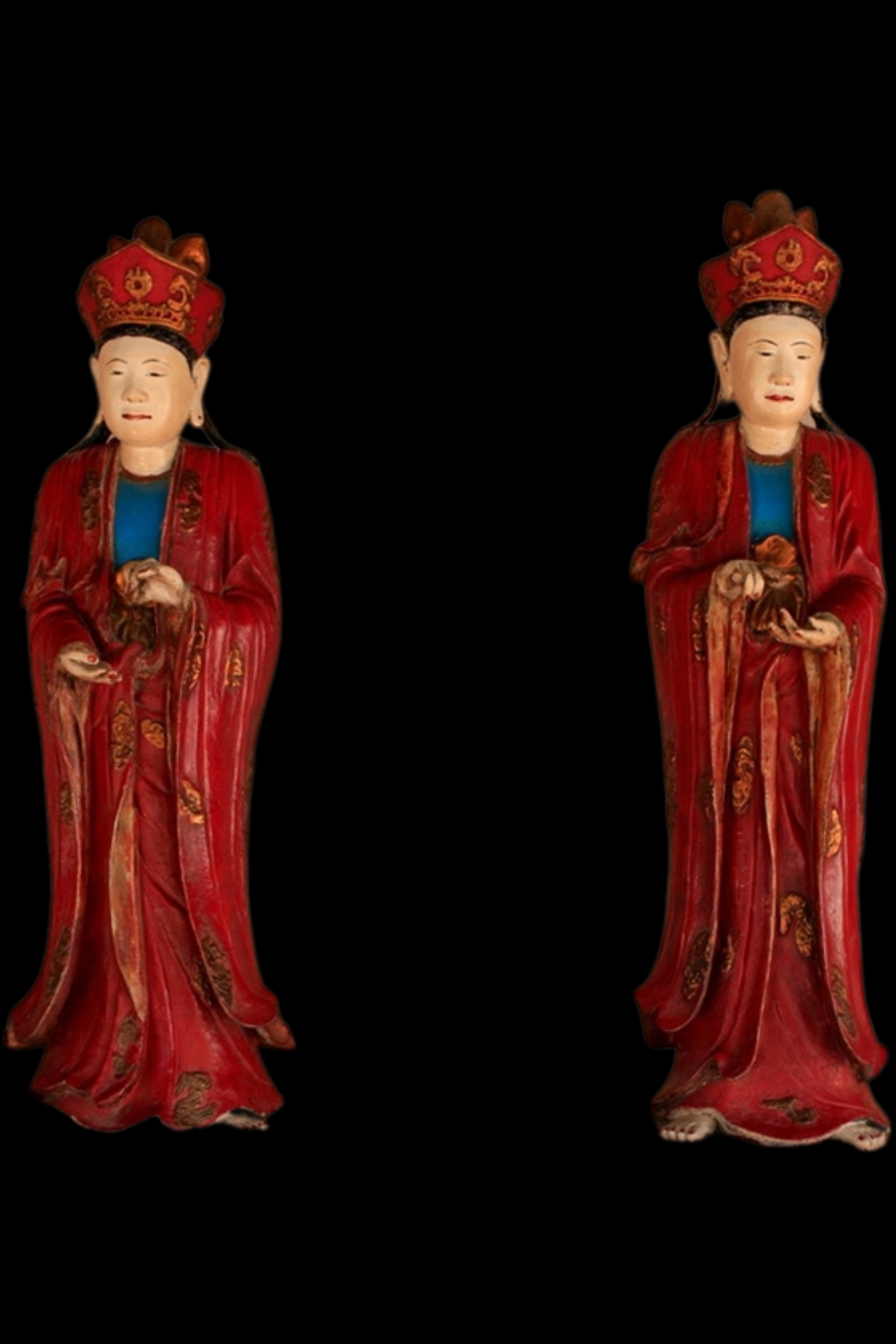
 Two clay statues of Bodhisattvas covered with lacquer at Nom pagoda
Nom pagoda, located in Nom village, Dai Dong commune, Van Lam district (formerly), now Dai Dong commune, Hung Yen province is renowned as an ancient pagoda dating back hundreds of years. Legend has it that the pagoda was built right in the middle of an ancient pine forest, on a small hermitage, and is therefore also known as “Linh Thong Ancient Pagoda”. Nom pagoda was rebuilt during the Later Le Dynasty, in the reign of Chinh Hoa, in the year Canh Than 1680, and has been renovated many times since then. Nevertheless, up to now, the pagoda has retained its original ancient, solemn and mysterious architectural features. Every year, this place attracts tens of thousands of tourists from all over the country who come to pilgrimage and worship.
Visiting Nom pagoda and witnessing firsthand the mysterious beauty of the ancient statues there truly reveals the talent of the people and the sacredness of the land and sky of Nom village. There are a total of 122 Buddha statues, large and small, made of wood and clay, scattered throughout Nom pagoda. These statues varying in size, vividly and expressively depict the Buddha’s path to enlightenment. The statues of the Three Saints, the Three Worlds, Amitabha Buddha, the Eight Vajra Deities, the Eighteen Arhats... have faces and forms that are extremely expressive, like ordinary people, yet mysterious and otherworldly. According to scientists, the sculptures at Nom pagoda are representative of 18th century sculpture art, demonstrating enduring vitality through the vicissitudes of time, war and harsh natural conditions.
The clay statues at Nom pagoda were submerged in water for months on end, but when the water receded, they reappeared intact and safe, much to the astonishment of the villagers. Scientists explain the enduring vitality of the statues here by attributing it to the masterful craftsmanship of ancient artisans, from the meticulous attention to detail in constructing the framework, sculpting the clay and applying paint to each statue. It is precisely because of the incredibly long lasting vitality of these statues that Nom pagoda has been honored by the Vietnam Book of Records Center as “The pagoda with the most ancient clay statues in the country”.
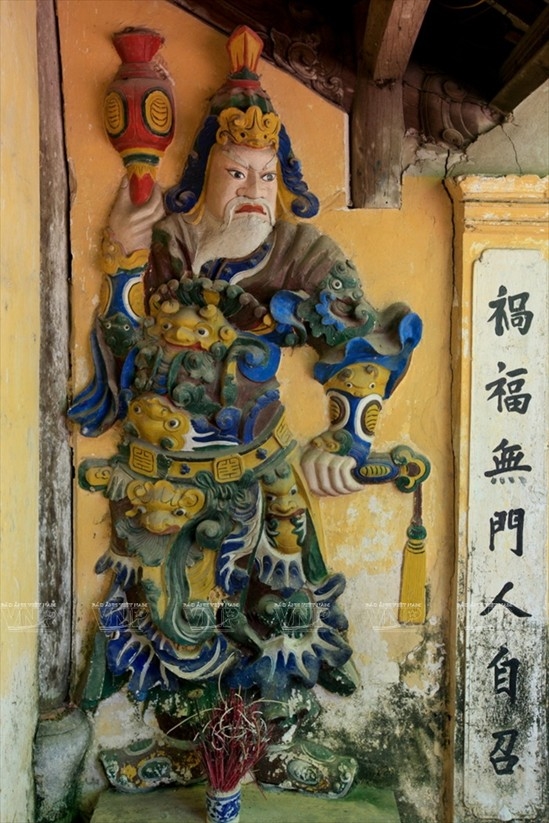 One of the two relief clay statues on either side of the gable of Nom pagoda
Besides over 100 clay statues, Nom pagoda also houses a precious bronze statue covered with a layer of gold called the Nine Dragons Buddha’s Birthday statue. In the tranquil atmosphere, imbued with the pure scent of incense, between the fading twilight in the west, perhaps there is no greater sense of serenity than admiring precious statues, immersing oneself in the resonant sounds of pagoda bells, feeling the gentle breeze, one’s heart becoming more peaceful, filled with distant nostalgia...
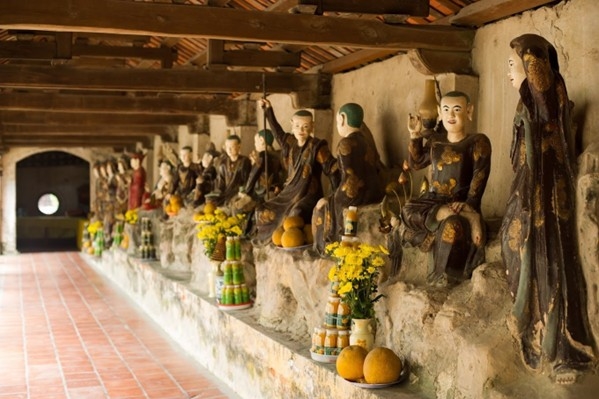 According to researchers, the materials used to sculpt the statues are a special mixture of purified clay mixed with slaked lime, molasses and shredded paper.
Visiting Nom pagoda today, we suddenly realize that this place is not only a tranquil Buddhist monastery amidst an ancient Vietnamese village, but also a magnificent forest retreat, a cultural highlight of Pho Hien - Hung Yen province. Most of the precious heritage at this temple continues to be preserved and its value promoted, contributing to the glorification of its ancient beauty and creating an environment and landscape for enjoying spiritual culture for local people and visitors from all over. Nom pagoda is truly a peaceful and serene place for learning the Dharma and cultivating oneself, a place that anyone who has visited once will be reluctant to leave. There, the influence of Buddhism is blended and deeply ingrained in Vietnamese culture in general and the culture of Nom village in particular./.
