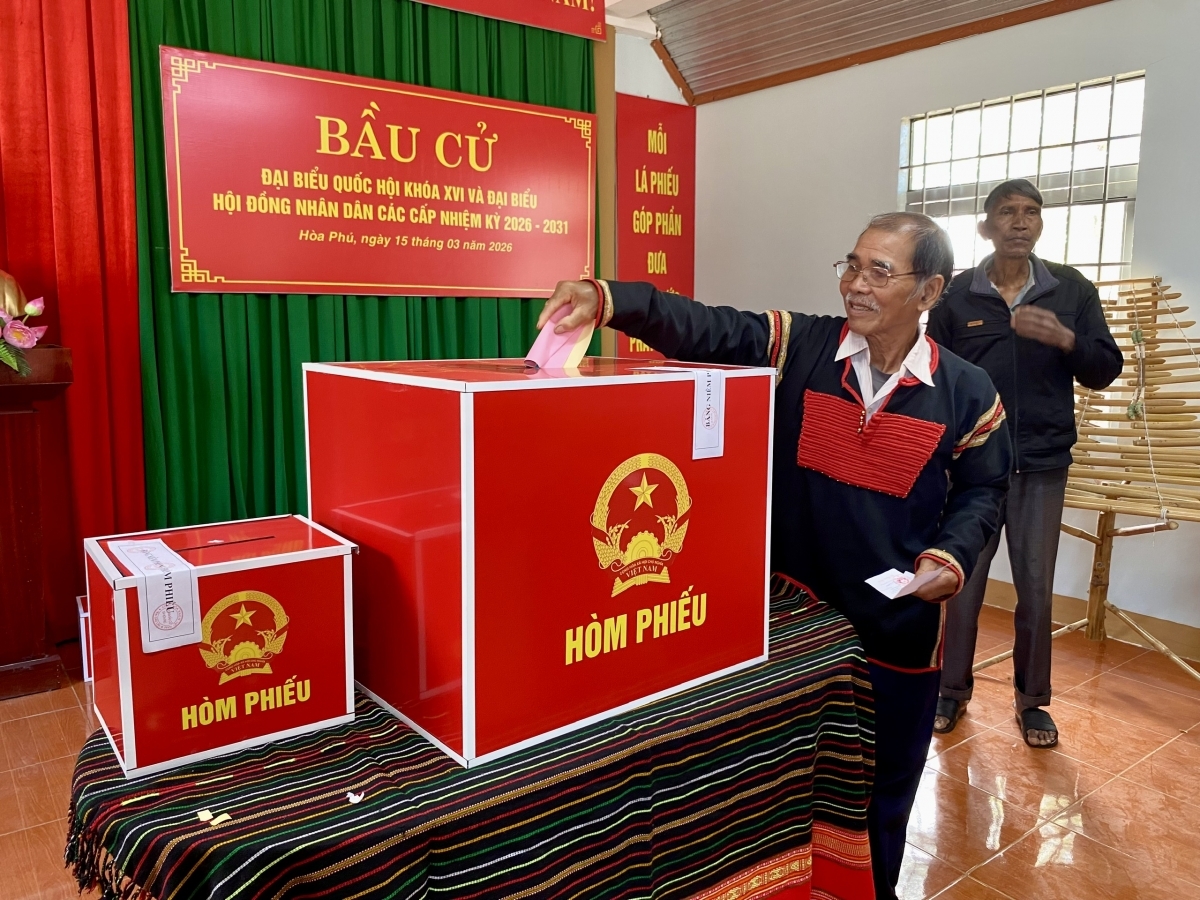
 Elder Y Thut Bya, of the E-de ethnic group in Hoa Phu commune, Dak Lak province, casts his vote for representatives to the 16th National Assembly and representatives to the People’s Councils at all levels for the term of 2026-2031
Keywords: The right of voting and running for office; Ethnic minorities; National Assembly; People’s Council.
1. Voting and running for office - fundamental political rights of citizens in a representative democracy
More than 80 years ago, on September 8th, 1945, President Ho Chi Minh signed Decree No. 14-SL on the General Election to elect National Assembly representatives. For the first time in the nation’s history, the right to vote and stand for election was fully and genuinely exercised, without discrimination based on gender, social class, ethnicity or religion.
On January 6th, 1946, the first general election in the history of the new Vietnam was officially held nationwide. 89% of the total number of voters participated, electing 333 representatives to the first National Assembly of the Democratic Republic of Vietnam. The first National Assembly marked a pivotal step in the development of the new democracy.
Democracy means “the people are the masters” and in Vietnam, there are two forms of democracy: direct democracy and representative democracy. “Democratic elections are always the most typical and important activity among the direct democratic activities of the people. Through elections for National Assembly representatives and People's Council representatives, citizens' rights and the people's right to self-governance are expressed in accordance with the true nature of a socialist rule of law state, which is that all power belongs to the people, is exercised by the people and is for the people.
In the 2013 Constitution, the supreme legal document guiding the entire legal system, the right of citizens to vote and stand for election is guaranteed openly, equally and without discrimination. Article 6 of the 2013 Constitution affirms: “The people exercise state power through direct democracy and representative democracy via the National Assembly, People’s Councils, and other state organs”. This constitutional provision stipulates that the supreme subject of state power belongs to the People. The National Assembly and People’s Councils are formed from the votes of the People and are accountable to the People.
Elections are a mandatory legal mechanism for transforming people's power into constitutional state power. Without elections, representative democracy is merely a formality; with elections but lacking equality and universality, people’s power is curtailed. Therefore, Article 6 ensures that all citizens, regardless of ethnicity, gender, religion or social class have equal political standing in participating in the creation of the state power apparatus.
Article 27 of the 2013 Constitution concretizes that principle by stipulating: “Citizens who are eighteen years of age or older have the right to vote and twenty-one years of age or older have the right to run for election to the National Assembly and the People’s Council. The exercise of these rights is prescribed by law”. This regulation has three levels of important legal significance:
Firstly, the right to vote and stand for election is constitutionally enshrined as a fundamental political right, on par with other civil and human rights recognized in the Constitution, this means that this right is supreme and any law or regulation that restricts or unjustly deprives it is unconstitutional.
Secondly, the Constitution chooses age as the sole universal criterion for citizenship, instead of criteria such as ethnicity, education level, wealth or social status... This approach clearly demonstrates the nature of absolute political equality: a Mong, E-de, Khmer… or Kinh person, upon reaching the age of 18, has an equal vote. This is the direct legal basis ensuring that ethnic minorities are not excluded from political life simply because of cultural differences or socio-economic conditions.
Thirdly, the phrase “the exercise of these rights is prescribed by law” aims to establish a mechanism to ensure enforcement. Specialized laws such as the Law on Election of National Assembly Deputies and People’s Council Deputies of 2015, amended and supplemented in 2025; The Law on the Organization of the National Assembly, the Law on the Organization of Local Governments,… are responsible for specifying the consultation process, nominating candidates, allocating the structure of representatives and ensuring conditions for all social groups, including ethnic minorities to participate equally.
Article 1 of the 2015 Law on Election of National Assembly Deputies and People’s Council Deputies stipulates four principles of elections: “The election of National Assembly deputies and People’s Council deputies shall be conducted according to the principles of universal suffrage, equality, direct election, and secret ballot”. Specifically:
Firstly, the principle of universality ensures the inclusiveness of citizens’ rights. According to regulations, as of the date the election is announced, citizens of the Socialist Republic of Vietnam who are eighteen years of age or older have the right to vote and those who are twenty-one years of age or older have the right to run for election to the National Assembly and People’s Councils at all levels, except in cases where they have been deprived of their rights by court judgments or decisions. Therefore, there are absolutely no barriers related to ethnicity, language, religion, or social status for citizens, meaning that ethnic minorities, regardless of where they live in Vietnam, have full legal and political rights like all other citizens.
Secondly, the principle of equality affirms the equal value of each vote. Equality in elections is not just about “one vote per person”, but also about “each vote having equal value”. Essentially, this is a rejection of all forms of political stratification. As a multi-ethnic nation, Vietnam holds particular importance in this principle, preventing the possibility of “the majority overpowering the minority” in institutional design and ensuring that all ethnic groups have the opportunity to participate in shaping state power.
Thirdly, the principle of direct election requires voters to choose their representatives themselves, without intermediaries. This regulation strengthens accountability between representatives and voters, ensuring that the voices of ethnic minority communities at the grassroots level are directly reflected in elected bodies.
Fourthly, the principle of secret ballot protects the right to free will. In conditions where many ethnic minorities have strong community bonds and close social relationships, secret ballot acts as a “legal shield”, helping voters make independent choices without pressure from any organization or individual.
However, governance practice shows that formal equality does not necessarily create substantive equality, especially for disadvantaged groups or those with limited development opportunities. Vietnamese election law has added mechanisms for the structure, composition, and allocation of representatives. Clause 3, Article 1 of the Law on Election of National Assembly Deputies and People’s Council Deputies of 2025 amends Article 9 of the Law on Election of National Assembly Deputies and People’s Council Deputies of 2015 with the following provision: Based on the number of People’s Council representatives to be elected in each administrative unit as stipulated in the Law on Organization of Local Government, after reaching a consensus with the Standing Committee of the Vietnam Fatherland Front and the People’s Committee at the same level, no later than 105 days before the election day, the Standing Committee of the Provincial/City People’s Council shall propose the structure, composition, and allocation of the number of people to be nominated to run for election as representatives to the Provincial People’s Council, in which the number of candidates from ethnic minorities shall be determined in accordance with the characteristics, ethnic structure and specific situation of each locality. The Standing Committee of the People’s Council of the commune, ward or special zone shall determine the structure, composition, and allocation of the number of people nominated to run for election as representatives to the People’s Council at the commune level, in which the number of candidates from ethnic minorities shall be determined in accordance with the characteristics, ethnic structure, and specific situation of each locality. Essentially, this is not a mechanism for preferential treatment or special privileges, but rather a legal measure to regulate inequality of opportunity. When ethnic minorities have limited access to education, information, infrastructure and resources, applying a purely competitive system could narrow their ability to participate in state power organs. Therefore, ensuring the proportion of representatives from ethnic minorities is a way to realize genuine equality - A principle widely recognized in modern rule-of-law theory.
In fact, the 16 National Assembly sessions show that this mechanism has been effective when the number of ethnic minority delegates has always been maintained at a relatively stable level, reflecting the true characteristics of a multi-ethnic country. This demonstrates that the right to vote and run for office of ethnic minorities not only exists legally, but has also transformed into a concrete presence within the state power apparatus. Specifically, the first National Assembly had 34/333 (10.2%) ethnic minority delegates; the second course: 56/453 (12.4%); the 3rd course: 60/453 (12.3%); the 4th course: 73/420 (17.4%); the 5th course: 71/424 (16.7%); the 6th course: 67/492 (13.6%); the 7th course: 74/496 (15%); the 8th course: 70/496 (14.1%); the 9th course: 66/395 (16.7%); the 10th course: 78/450 (17.3%); the 11th course: 86/498 (17.26%); the 12th course: 87/493 (17.6%); the thirteenth course: 78/500 (15.6%). 14th course: 86/496 (17.3%); 15th course: 89/499 (17.8%); 16th course: 76/500 (15.2%).
Thus, the proportion of National Assembly deputies from ethnic minorities has tended to increase sharply since the 9th National Assembly and has remained stable at a high level from the 12th National Assembly onwards, consistently exceeding the proportion of the ethnic minority population. The representation structure is diverse, in addition to ethnic minorities with large populations, such as: Tay, Thai, Muong, Khmer, Mong… and representatives of ethnic minorities with very small populations, such as the Brau and Lu, appeared for the first time in the 15th National Assembly. The 15th National Assembly recorded 17.8% of delegates being ethnic minorities, which is very close to the target stipulated in Clause 2, Article 8 of the Law on Election of National Assembly Deputies and People’s Council Deputies of 2015, which is: “At least eighteen percent of the total number of people on the official list of candidates for National Assembly representatives are ethnic minorities”, ensuring that the voices of ethnic minority groups are included in the highest power body. The percentage of ethnic minorities participating in the Provincial People’s Councils for the term of 2021-2026 is 17.09%, at the district level is 18.23% and at the commune level is 20.55%.
If the Constitution and the Election Law establish the right to vote and stand for election legally, ethnic policy plays a crucial role in ensuring the socio-administrative conditions necessary for those rights to be exercised effectively. In other words, the law grants power, while ethnic policy creates the ability to exercise that power. These two systems are not separate but operate in a complementary and interdependent relationship.
According to Decree 05/2011/ND-CP, ethnic policies include: Policies on investment and resource utilization; Policies on sustainable development investment; Policies on education and training development; Policies on ethnic minority cadres; Policies on influential individuals in ethnic minority areas; Policies on cultural preservation and development; Policies on information and communication; Policies on legal dissemination, education and legal assistance… These policies are directly related to exercising the right to vote and run for office. In fact, the biggest barriers to the political rights of ethnic minorities are geographical distance, limitations in language, education level and ability to access legal information... Therefore, ethnic policy serves as a prerequisite mechanism for guaranteeing political rights.
Firstly, through the dissemination and education of laws in appropriate forms and languages, ethnic minority policies help ethnic minority people understand their rights and obligations regarding elections and candidacy. Only when they understand the process, the list of candidates, the time and the location of voting can ethnic minority voters participate in elections proactively.
Secondly, through training, development and planning for ethnic minority cadres, ethnic policies directly create a pool of personnel for candidacy. The right to run for office requires candidates to have the capacity to participate in political activities, knowledge of the law, skills in state management. Training ethnic minority cadres is a way to transform the right to run for office from legal capacity into practical competence.
Thirdly, through the use of spoken and written language and respect for cultural specificities, ethnic policies create a political communication environment suitable for the community. This is especially important in the consultation process, election campaigning and voter outreach. When information is conveyed in familiar languages, the gap between representatives and voters is narrowed and the quality of representative democracy is enhanced.
Fourthly, ethnic policy is linked to the requirement of ensuring the participation of ethnic minorities in the political system, creating a basis for electoral bodies to build a rational representative structure. This is a direct link between ethnic policy and electoral law: one side prepares human resources, the other designs the selection and representation mechanisms.
From an institutional perspective, it can be seen that if only the Election Law exists, the political rights of ethnic minorities are only formally guaranteed; if only ethnic policies exist without a democratic electoral mechanism, their voices will have difficulty reaching the power system. Only when these two systems operate simultaneously can rights become a reality. Therefore, ethnic policy is the structural guarantee that ensures the voting and candidacy rights of ethnic minorities do not stop at nominal equality, but reach substantive equality.
2. International commitments and the domestication of human rights standards
Vietnam is a signatory to numerous international human rights conventions, including the Convention on the Elimination of All Forms of Racial Discrimination (CERD). This Convention stipulates that member states commit to prohibiting and eliminating racial discrimination in all its forms, ensuring equal rights before the law for all people, without distinction as to race, color, national origin or ethnicity, especially in the right to vote.
The Vietnamese government has incorporated this provision of the CERD Convention into its domestic law through the Constitution and the Election Law, as analyzed above. The legal framework regarding the right to vote and stand for election is consistent, from the Constitution and the Election Law to ethnic policies, aiming to ensure the genuine participation of ethnic minorities in the political and legal life of the country. In particular, the Constitution affirms the principle of equality in political rights and the Election Law details this right in a transparent and superior manner.
Ethnic policy creates practical conditions for ethnic minorities to fully and effectively exercise their rights through modern electoral processes...
Since the historic General Election on January 6th, 1946, the Vietnamese National Assembly has gone through 16 terms. The election of the 16th National Assembly and People's Councils at all levels for the term of 2026-2031, to be held on March 15th, 2026, is a particularly important political event for the country, taking place in the context of the successful conclusion of the 14th National Congress of the Party. There are 76 delegates from ethnic minorities (15.2%), including, for the first time, a member of the O Du ethnic group - one of the smallest ethnic groups in Vietnam – elected to the National Assembly.
3. Conclusion
The right to vote and stand for election of ethnic minorities in Vietnam is guaranteed by a multi-tiered institutional structure, from the constitutional foundation and electoral legal framework to the system of ethnic policies. The Constitution establishes political equality; the Election Law concretizes this through a mechanism of equal, universal, direct and secret ballot; ethnic policies create conditions for the substantive implementation of this right. This combination not only expands the participation of ethnic minorities in political life, but also strengthens the representativeness, inclusiveness and legitimacy of the elected apparatus in the new stage of national development.
References
1. National Assembly Electronic Portal, History of the Vietnamese National Assembly
2. National Assembly Electronic Portal (2026), Candidates for the 16th National Assembly: Nearly 45% of candidates are female, over 21% are ethnic minorities., https://quochoi. vn/hoatdongcuaquochoi/cackyhopquochoi/ quochoikhoaxv/kyhopthu10/Pages/thong-tin-khac. aspx?ItemID=98383
3. Communist Party of Vietnam (2019), Conclusion No. 65-KL/TW dated October 30th, 2019 of the Politburo on continuing to implement Resolution No. 24-NQ/TW dated March 12th, 2003 of the 9th Central Committee on ethnic affairs.
4. Phuc Hang - VNA/Vietnam+ (2026). National Assembly and People’s Council elections: Ensuring democratic and rigorous consultation processes, https://hoidongbaucu. quochoi.vn/bai-viet/bau-cu-quoc-hoi-va-hdnd-bao dam-cac-quy-trinh-hiep-thuong-dan-chu-chat-che
5. Central Human Rights Steering Committee, Information and propaganda documents on ensuring the rights of ethnic minorities.
6. Vietnam News Agency (2026), Structure of 500 elected National Assembly Deputies of the 16th term, https://www. vietnamplus.vn/co-cau-500-nguoi-trung-cu-dai bieu-quoc-hoi-khoa-xvi-post1100274.vnp
