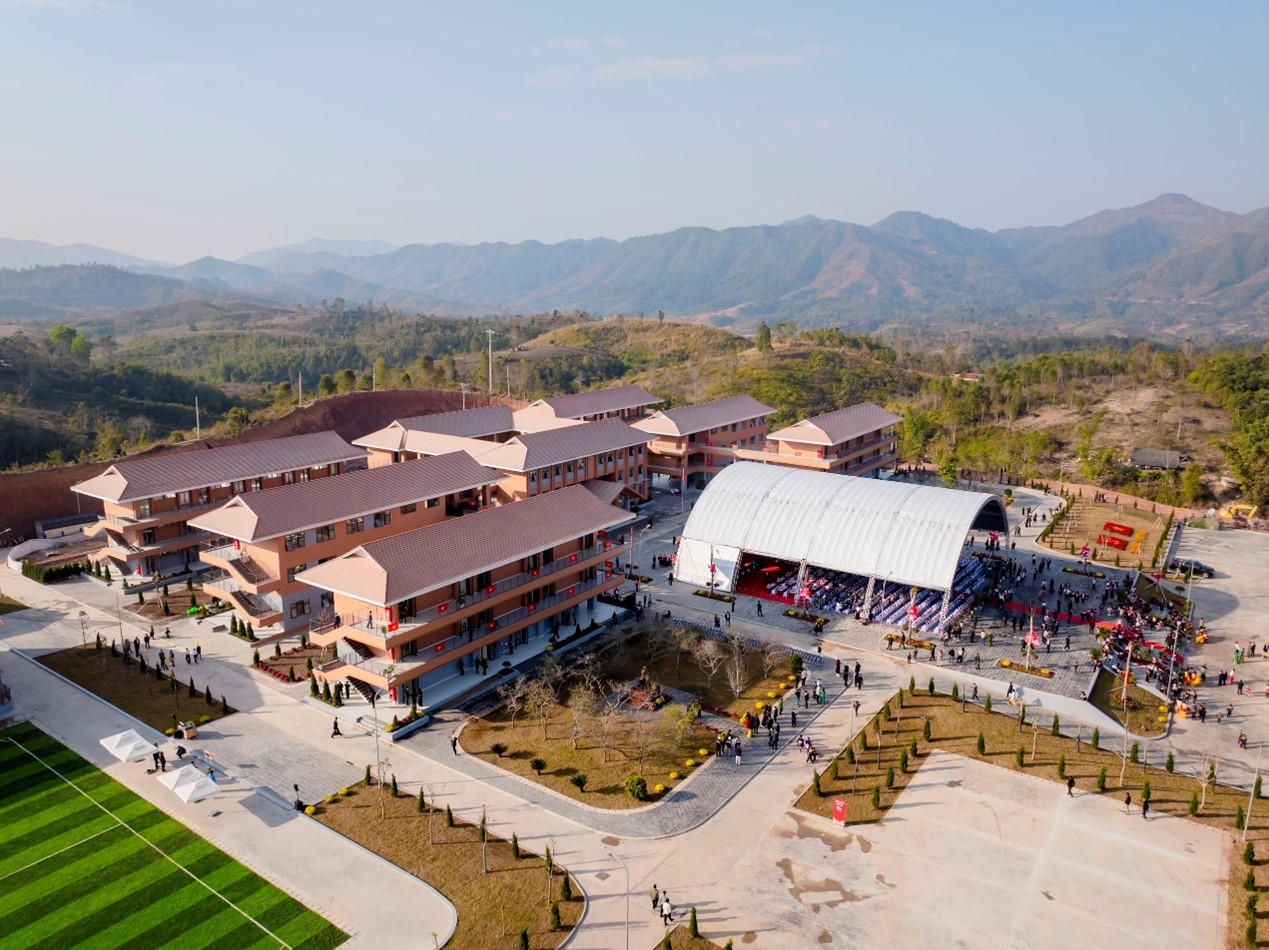
 The Party and State of Vietnam have always given special attention and investment to the field of education in ethnic minority and mountainous areas. (In the photo: Model of Si Pa Phin Primary and Secondary Boarding School, Dien Bien Province)
Keywords: Ethnic affairs in 2025; Vision for the period of 2026-2030.
1. Introduction
In 2025, the field of ethnic affairs will mark a pivotal stage in the implementation of ethnic policies towards modernizing governance and enhancing access to sustainable development in ethnic minority and mountainous areas. In the context of a volatile socio-economic environment, including the prolonged impact of climate change, labor migration and shifts in livelihood models, ethnic affairs continues to be identified by the Party and the State as a strategic task aimed at narrowing the development gap and consolidating national unity (in accordance with the spirit of Conclusion No. 65-KL/TW dated October 30th, 2019, of the Politburo on continuing to implement Resolution No. 24-NQ/TW of the Central Committee of the 9th Party Congress on ethnic affairs in the new situation); Decree No. 127/2024/ND-CP dated October 10th, 2024 of the Government amending and supplementing a number of articles of Decree No. 05/2011/ND-CP dated January 14th, 2011 of the Government on ethnic affairs;...). The achievements in 2025 reflect the efforts of the Party and the State in perfecting institutions, implementing the National Target Program for socio-economic development in ethnic minority and mountainous areas, improving essential infrastructure, supporting livelihoods and preserving culture, at the same time promoting digital transformation to enhance governance efficiency.
However, the achievements in the field of ethnic affairs in 2025 also pose many new demands for the period of 2026-2030. The challenge lies in ensuring the sustainability of development models, strengthening grassroots implementation capacity, building big data systems to support policy planning and addressing challenges such as: Natural disasters, resource depletion and the erosion of traditional culture. In this context, analyzing the results of 2025 and developing a strategic vision for the next phase is not only scientifically significant but also has important practical value, contributing to comprehensively guiding ethnic affairs in the coming period.
2. Research results
2.1. General context of ethnic affairs in 2025
2025 is a particularly important year for the country, to be a year of acceleration, breakthroughs and reaching the finish line; this year marks the beginning and preparation for the term of 2026-2031 and holding immense significance in successfully implementing the Resolution of the 13th National Congress of the Party, commemorating the 95th anniversary of the Party’s founding, the 50th anniversary of the liberation of the South and national reunification, the 135th anniversary of President Ho Chi Minh’s birth, the 80th anniversary of the nation’s founding and to be the year of holding Party congresses at all levels, leading up to the 14th National Congress of the Party.
In particular, the field of ethnic affairs marks a pivotal stage in the implementation of the National Ethnic Affairs Strategy for the period of 2021-2030, in the context of the nation facing many intertwined opportunities and challenges. Firstly, the socio-economic recovery process after the Covid-19 pandemic continues to create a need for restructuring development models, at the same time requiring more effective exploitation of the potential of ethnic minority and mountainous regions, where significant development gaps still exist in infrastructure, education, healthcare and sustainable livelihoods. Furthermore, the trend of deep international integration opens up new areas of cooperation in human resource development, technology transfer and the digitalization of state administration, but at the same time increasing competitive pressure, especially in border areas, which are closely linked to the living space of many ethnic minority communities.
From a policy perspective, 2025 marks the first year that the new phase of the National Target Program will be adjusted to enhance integration, focusing on addressing structural bottlenecks, as well as promoting science and technology and digital transformation in state management of ethnic affairs… creating breakthroughs and new developments in the coming time.
2.2. Some results of ethnic affairs in 2025
Establishment of the Ministry of Ethnic and Religions. Based on Resolution No. 56-NQ/TW dated November 25th, 2024, of the 13th Central Committee of the Communist Party of Vietnam; Conclusion No. 09-KL/BCĐ dated November 24th, 2024, of the Central Steering Committee on summarizing the implementation of Resolution No. 18-NQ/TW, the Ministry of Ethnic and Religions is established on the basis of the Committee for Ethnic Minority Affairs taking over additional functions, tasks and organizational structure for state management of religion from the Ministry of Interior. On March 1st, 2025, the Ministry of Ethnic and Religions held “a ceremony to announce the National Assembly’s Resolution establishing the Ministry of Ethnic and Religions and the Decision on personnel matters”. The establishment of the Ministry of Ethnic and Religions demonstrates the profound concern of the Party and State leaders for ethnic and religious issues; it signifies the promotion of activities and movements within ethnic and religious communities to serve the revolutionary cause of protecting, building and developing the country. On June 3rd, 2025, the Government issued Decree No. 114/2025/ND-CP amending Clause 12, Article 3 of Decree No. 41/2025/ND-CP dated February 26th, 2025, which stipulates the functions, tasks, powers, and organizational structure of the Ministry of Ethnic and Religions.
Successfully organized the First Congress of the Party Committee of the Ministry of Ethnic and Religions for the term of 2025-2030. The Congress thoroughly grasped the seven key resolutions of the Politburo, creating an important institutional foundation to lead the country into a new era, contributing to the realization of Vietnam’s goal of becoming a developed, high-income country by 2045.
Building and perfecting institutions and policies. 2025 marks a significant step forward in perfecting ethnic institutions and policies in a way that is synchronized, effective and relevant to the realities of ethnic minority and mountainous areas.
Completing the National Target Program for socio-economic development in ethnic minority and mountainous areas for the period of 2021-2025. National Target Program for Socio-Economic Development of Ethnic Minority and Mountainous Regions in the period of 2021-2030, Phase I: From 2021 to 2025 (National Target Program for Ethnic Minorities and Mountainous Areas), the basic objectives of the Program have been achieved (6 out of 9 target groups of the Program have basically met or exceeded the set plan, while the global poverty rate is trending upwards, Vietnam’s poverty rate has sharply decreased from 58% in 1993 to 1% in 2025, the poverty rate among ethnic minorities is approximately 11%); A review of the 5-year implementation of the National Target Program for socio-economic development in ethnic minority and mountainous areas, with a total investment of over 137 trillion VND, has created significant changes in the ethnic minority and mountainous areas.
The demolition of temporary and dilapidated houses was completed ahead of schedule. According to reports from 34 localities, the Ministry of Public Security, the Ministry of National Defense, the Central Committee of the Vietnam Fatherland Front, and related agencies, the total number of houses newly built or renovated is 334,234 (of which, 255,310 are newly built and 78,924 are renovated)... Accordingly, by 2025, the goal of eliminating temporary and dilapidated houses for ethnic minority households will be completed ahead of schedule, reflecting the effective coordination between the State, businesses and the community.
Proactively accompanying localities in the operation of the two-tiered government system. The Ministry of Ethnic and Religions successfully organized the National Conference to evaluate ethnic and religious affairs after the reorganization of the organizational structure and the implementation of the two-tiered local government system (August 12th, 2025). At the same time, the Ministry established working groups led directly by Ministry leaders to conduct on-site inspections in a number of provinces, promptly resolving difficulties and obstacles.
Promoting science and technology, governance and digital transformation: Project 06 in ethnic affairs. Science, technology, and digital transformation in ethnic affairs are being strongly promoted in accordance with the spirit of Resolution No. 57-NQ/TW dated December 22th, 2024, of the Politburo on breakthroughs in the development of science, technology, innovation and national digital transformation, creating a foundation for enhancing research capacity, governance and operational efficiency. In particular, the national database on ethnic minorities has been initially completed, supporting data-driven policy analysis. Local authorities are strengthening the application of information technology in monitoring and tracking program progress, ensuring transparency and optimizing resources. At the same time, models supporting community digital transformation help narrow the information access gap and improve the quality of public services.
Construction begins on 100 schools in border communes. In accordance with Notice No. 81-TB/TW dated July 18th, 2025, of the Politburo on the policy and investment in school construction in 248 border communes, on November 9th, 2025, localities simultaneously commenced construction of 72 boarding schools for primary and lower secondary levels in border communes (28 schools had already been started previously)...
Construction begins on upgrading specialized schools. In 2025, the Ministry of Ethnic and Religions held a groundbreaking ceremony for the infrastructure investment project for 05 specialized schools, including: Central Ethnic Minority University Preparatory School, Sam Son University Preparatory School, Nha Trang Central Ethnic Minority University Preparatory School, Ho Chi Minh City Ethnic Minority University Preparatory School, Viet Bac Highland High School, with a total investment of nearly 800 billion VND…
The Ethnic Hotel was inaugurated. On December 19th, 2025, the Ministry of Ethnic and Religions held the inauguration ceremony for the Ethnic Hotel. This project holds profound significance for ethnic and religious communities and to be part of the simultaneous groundbreaking, inauguration and technical opening ceremonies for 334 key infrastructure projects nationwide, especially in anticipation of the 14th National Congress of the Communist Party of Vietnam.
International cooperation on ethnic affairs. The Ministry of Ethnic and Religions has exchanged information with ethnic affairs agencies in countries such as Laos, China, Thailand, Cambodia,… in order to implement the signed Cooperation Agreement and renew the Cooperation Agreements for 2025. At the same time, expanding relations with other partners in the region and around the world, such as Japan, India, Australia, New Zealand, Ireland,...
The Ministry of Ethnic and Religions successfully organized the First National Emulation Congress (the period of 2025-2030). This is a politically significant event, a grand celebration for all officials, employees and workers throughout the entire sector.
Preserving culture and promoting sustainable development in ethnic minority and mountainous areas. The preservation of ethnic minority cultures is being implemented in a way that harmoniously combines heritage preservation with the promotion of sustainable development. Many models of on-site conservation, festival restoration, cultural space preservation and traditional crafts are being implemented in parallel with community-based tourism development. The digitization of heritage is being accelerated, creating a foundation for passing it on to future generations. These efforts contribute to strengthening cultural identity while expanding sustainable livelihood opportunities for the community.
Mobilizing resources and community participation. Significant progress has been made in mobilizing resources for the development of ethnic minority and mountainous areas through expanded public-private partnerships, effective integration of targeted programs and attracting the participation of businesses, social organizations. In particular, the role of the community as the main stakeholder is emphasized, as demonstrated through models of livelihood development, resource management and investment monitoring at the local level. A community-based approach contributes to enhancing sustainability, transparency and efficient resource utilization.
2.3. Vision for ethnic affairs in the period of 2026-2030
Firstly, a key direction is to shift from a support-oriented mindset to a development-oriented mindset, with strengthening the internal capacity of ethnic minority communities as the foundation. This includes developing high-quality human resources, enhancing self-governance capabilities, promoting entrepreneurship, and building sustainable livelihood models based on local potential, such as: specialty agriculture, forestry, cultural and ecological tourism and local knowledge-based economy. The state plays a facilitating role by providing institutions, infrastructure, technology and support for market access.
Secondly, vision for the period of 2026-2030 needs to improve the management system for ethnic affairs in a digitalized and synchronized manner. Establishing a national database on ethnic minorities is a prerequisite for improving the quality of policy planning, monitoring and evaluation. The multi-level, multi-sectoral governance model will be strengthened to ensure effective coordination between the central and local governments, as well as between ministries and sectors, in implementing the program for the development of ethnic minority and mountainous areas.
Thirdly, cultural preservation and sustainable social development will continue to be pillars in the coming period. This vision aims to protect cultural diversity through community empowerment mechanisms, enhancing the transmission of local knowledge and integrating digital technology for cultural preservation, promotion and education. Conservation is linked to development to create economic momentum while preserving heritage values.
Fourthly, the period of 2026-2030 also prioritizes adaptation to climate change and sustainable resource management, considering these as vital conditions for the livelihoods of many ethnic minority groups. Ecological and cultural approaches will be promoted to enhance resilience, risk management and ensure long-term livelihood security.
3. Discussion
The results of the 2025 National Target Program show positive and relatively comprehensive changes in many areas, from improving institutions and socio-economic development to cultural preservation and strengthening governance.
However, when compared with the long-term goals for the period of 2026-2030, it is evident that the gap between achievements and the requirements for sustainable development in ethnic minority and mountainous areas remains significant, highlighting the need for continued innovation in thinking, organizational models and policy implementation methods.
One key issue requiring discussion is the sustainability of poverty reduction and livelihood development outcomes. This requires the development of a new economic model that is based on local knowledge, appropriate technology and a greater emphasis on the role of the community as the main actors compared to the previous period.
In addition, challenges related to governance and digital transformation continue to be bottlenecks. The lack of synchronization in ethnic minority databases across different levels leads to inconsistencies in policy monitoring and evaluation. The digital capabilities of the grassroots workforce have not yet met the goals of building modern governance. The disparity in digital access among ethnic minority groups also creates a new “digital divide”, which can affect development opportunities.
The issue of cultural preservation in the context of globalization also needs to be studied in greater depth. The commercialization of culture, without proper control mechanisms and community participation can lead to a loss of identity or the reproduction of a distorted image of ethnic minority culture. This suggests that vision for the period of 2026-2030 needs to pay more attention to balancing conservation and development.
Overall, ethnic affairs work needs to enter a new phase of development with a foundation of science, modern governance and broad community participation to achieve inclusive and sustainable development goals.
4. Conclusion
The results of ethnic affairs in 2025 reflect positive changes in state management and development of ethnic minority and mountainous areas, with clear progress in institutions, infrastructure, livelihoods, culture and governance. Accordingly, vision the period of 2026-2030 requires the development of a modern, data-driven governance model, promoting the role of communities as key stakeholders and strengthening regional linkages. At the same time, cultural preservation linked to sustainable development should be considered a strategic pillar. Therefore, the new phase requires a harmonious combination of policies, resources and community participation, aiming towards inclusive, equitable and sustainable development for ethnic minority and mountainous areas.
* Journal of Ethnic and Religious Research
References
1. Nguyen Duy Dung (2025), Ethnic Policy: Achievements and Issues in the New Era, Journal of Ethnic and Religious Research, No. 1 (September).
2. PV (2025), Outstanding events in the field of ethnicity and religion in 2025, Journal of Ethnic and Religious Research, No. 4 (December).
3. Kim Thanh (2025), 12 outstanding achievements of the Ministry of Ethnic and Religions in 2025, https://thanhtra.com.vn/ky-nguyen-moi-cua-dan-toc-6E454529F/12-dau-an-noi-bat-cua-bo-dan-toc-va-ton-giao-trong-nam-2025-fd59ff889.html
