Keywords: Local knowledge; Sustainable development; Ethnic minority people in the northern mountainous area.
Received: 25/11/2025; Reviewed: 30/11/2025; Revised: 4/12/2025; Accepted: 10/12/2025.
1. Introduction
The ethnic minority and mountainous areas of Northern Vietnam are unique living spaces where ethnic communities have created and accumulated a rich system of local knowledge over many generations. This knowledge is the result of a long process of interaction between humans and a diverse and complex natural environment; it is preserved through social practices, rituals, customs, labor skills and production experience. In the context of sustainable development being considered a national strategic requirement, local knowledge is increasingly proving its value in resource management, environmental protection, climate adaptation, ensuring livelihood security and maintaining the cultural identity of communities.
However, industrialization, urbanization and the impact of the market economy are posing many challenges to the preservation and promotion of local knowledge. The erosion across generations, the risk of cultural assimilation, changes in the natural environment and limitations in policy mechanisms put much knowledge at risk of disappearing. Therefore, addressing the issue of researching local knowledge not only has scientific significance but also profound practical value, contributing to guiding sustainable development models suitable to the specific cultural and social conditions of ethnic groups in the northern mountainous region, ensuring harmony between economic growth, social equity and long-term ecosystem preservation.
2. Research Results
2.1. Characteristics of local knowledge in the northern mountainous area
The local knowledge of ethnic minority communities in the northern mountainous areas has been formed and accumulated over many generations, closely linked to the ecological environment of high mountains, forests, terraced fields and unique socio-cultural conditions. This is an integrated knowledge system that reflects both practical production experience and contains profound cultural and spiritual values, creating a unique identity for each ethnic group.
Firstly, practical experience is demonstrated in sustainable farming methods such as terraced rice cultivation by the Mong and Dao people; irrigation techniques using wooden troughs, dams, stone canals by the Tay and Nung people; or crop rotation and intercropping to protect soil fertility. This knowledge not only helps adapt to the complex mountainous terrain but also contributes to maintaining ecological balance.
Secondly, local knowledge is highly ecological, structured on a foundation of thorough understanding of nature. Many communities have rich knowledge calendar related to weather forecasting, water conservation, forest use and management. A typical example is the “forbidden forest” or “sacred forest” knowledge of the Thai, Muong, and Dao ethnic groups, where communities establish their own rules to protect headwater forests and primary forests, thereby protecting water resources and reducing the risk of natural disasters. The medicinal plant classification systems of the Dao and Mong people, or the traditional remedies of the Thai people demonstrate accuracy and depth in identifying local vegetation.
Thirdly, local knowledge is communal and oral, transmitted through practices, rituals and cultural activities. Teaching through hands-on experience, collective labor, or agricultural rituals helps preserve knowledge deeply rooted in the ethnic group’s sensibilities. This helps the community maintain its cultural identity while strengthening solidarity in the use and management of resources.
Fourthly, local knowledge demonstrates adaptability. Ethnic groups in the northern mountainous regions are constantly adapting their knowledge to cope with natural disasters, plant and animal diseases and climate change. This flexibility is clearly demonstrated through changes in crop structure, the application of ecological farming models, or the combination of traditional knowledge with new techniques in production. Adaptability helps communities maintain their livelihoods in a changing environment.
Fifthly, local knowledge carries spiritual and cultural value, linked to agricultural beliefs, festivals, residential customs, housing architecture and interactions with nature. Unwritten conventions related to forest exploitation, land use, or water resource protection reflect an attitude of respect for nature as a living entity, thereby forming the ecological ethical foundation of the community.
Therefore, local knowledge in the northern mountainous region is a multi-layered system, encompassing both scientific and cultural aspects, as well as practical and symbolic knowledge. Its value lies not only in its ability to help communities maintain sustainable livelihoods but also in its role in shaping identity, stabilizing society and protecting the environment. This is a crucial resource that needs to be studied, preserved and integrated into sustainable development models in the new period.
2.2. The role of local knowledge in sustainable development
Firstly, regarding environmental and resource protection. Local knowledge of ethnic minority communities in the northern mountainous regions plays a fundamental role in environmental management and protection and the sustainable use of natural resources. Through a system of accumulated experience over generations, such as crop rotation rules, forest worship rituals, water resource protection practices and farming techniques suitable for sloping terrain, communities have formed effective self-governance mechanisms, limiting overexploitation and ensuring ecological balance. This knowledge not only contributes to maintaining biodiversity but also creates a cultural and social framework for harmonious interaction between humans and the environment.
Secondly, regarding economic development and livelihoods. Local knowledge plays a fundamental role in the sustainable livelihood development of ethnic minorities in the northern mountainous area through the accumulation of farming experiences suitable to the specific ecological conditions. Skills such as selecting native varieties, circular shifting cultivation, terraced fields and adaptive livestock farming techniques help maintain stable productivity and minimize the risk of natural disasters. At the same time, local knowledge also guides the development of diverse livelihood structures, combining agriculture, forestry, fisheries and traditional handicrafts, creating highly self-reliant economic models that contribute to increased income and sustainable poverty reduction for ethnic minority communities.
Thirdly, regarding social and cultural development. Local knowledge plays a crucial role in strengthening the socio-cultural foundations of ethnic minority communities in the northern mountainous area by maintaining traditional values, behavioral norms and community institutions. This knowledge not only contributes to preserving language, festivals and folklore, but also promotes social cohesion and strengthens ethnic identity in the context of globalization. At the same time, local knowledge creates a cultural framework for communities to regulate their behavior, manage resources and adapt to environmental changes, thereby ensuring social stability and sustainable development…
Local knowledge plays a crucial role in maintaining and promoting the cultural and social values of ethnic minority communities in the northern mountainous area. Traditional customs, rituals, arts and community life knowledge systems not only preserve national identity but also strengthen social relationships and enhance community cohesion. Respecting, protecting and utilizing local knowledge helps to form a solid social foundation, while also creating conditions for sustainable development programs linked to culture, contributing to the promotion of comprehensive and harmonious development between people and the environment.
Fourthly, regarding climate change adaptation, local knowledge plays a crucial role in helping ethnic minority communities in the northern mountainous areas adapt to climate change. Traditional experiences in farming, forest management, water resource protection and crop selection help minimize the risks of natural disasters and agricultural losses. Combining local knowledge with modern scientific solutions not only enhances adaptability but also promotes sustainable development and harmony between humans and the natural environment.
2.3. Preserving and promoting local knowledge
The preservation and promotion of local knowledge in the ethnic minority and mountainous areas of Northern Vietnam today reveals a complex picture of enduring values and increasing risks of erosion. Firstly, under the influence of the market economy, labor migration, changes in livelihoods and globalization, much local knowledge associated with agricultural practices, resource management and community rituals is clearly declining. A segment of young people tend to move away from traditional activities and have less access to the wealth of knowledge of previous generations, leading to a breakdown in transmission and practice. In addition, changes in production structures and pressure to exploit resources have significantly reduced cultural and ecological spaces, where local knowledge is formed and practiced.
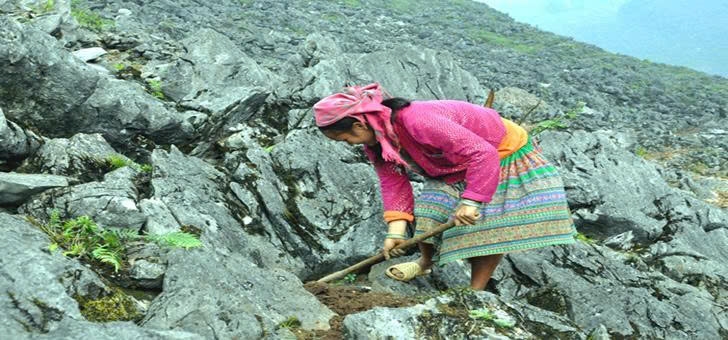 The experience of growing corn in rocky crevices has been passed down through many generations by the people of the highlands
Nevertheless, many communities have preserved valuable knowledge systems related to sustainable farming, sacred forest management, water resource protection, traditional medicine and the organization of social and cultural life. This knowledge continues to play a crucial role in climate adaptation, disaster prevention and maintaining stable livelihoods. Some localities have begun implementing models for reviving festivals, preserving traditional crafts, digitizing community knowledge, or developing cultural tourism based on local knowledge. However, these activities remain fragmented, lacking a coordinated inter-sectoral mechanism and failing to create strong incentives for community participation.
In terms of policy, the State has issued many programs and projects related to cultural preservation and sustainable development in ethnic minority and mountainous areas. However, the integration of local knowledge into development strategies remains limited. Some new policies only focus on “formal” preservation, emphasizing tangible heritage rather than intangible knowledge; or they are implemented in an imposed manner, not stemming from the needs and priorities of the community. This leads to a situation where local knowledge is sometimes distorted, commercialized or detached from the ecological and cultural context that gives it its value.
Furthermore, the research, inventory and documentation of local knowledge lack a systematic approach. Many important knowledge groups remain underdocumented, while interdisciplinary research on local knowledge for sustainable development is still quite limited. The lack of experts, financial resources and appropriate approaches also limits the potential for scientific, community participatory conservation.
Overall, the current situation demands a holistic, flexible approach that respects the intellectual property rights of the community. Preserving local knowledge is only truly effective when that knowledge is put into practice in daily life, passed down through generations and recognized as a vital resource for sustainable development.
3. Discussion
In order to preserve and promote the value of local knowledge and ensure sustainable development in the ethnic minority and mountainous regions of Northern Vietnam today, we need the following basic orientations and solutions:
Firstly, integrating local knowledge into the State’s development strategy is crucial. This integration is essential to ensure sustainability and practical relevance. This requires mechanisms for recognizing, standardizing and integrating traditional knowledge into socio-economic planning, resource management, and community development, creating a synergy between folk wisdom and modern science.
Secondly, enhancing community capacity is crucial. Strengthening community capacity is a key condition for preserving and effectively applying local knowledge in sustainable development. This requires strengthening bilingual education, training in resource management skills, supporting appropriate technology transfer and promoting the role of citizens as stakeholders in decision-making processes.
Thirdly, developing livelihoods based on local knowledge. Developing livelihoods based on local knowledge requires a harmonious combination of traditional skills with modern science and technology to enhance product value, expand markets, and ensure sustainable livelihoods. This approach helps communities utilize resources rationally, increase income, and preserve their cultural identity.
Fourthly, strengthening scientific and technological cooperation. Promoting cooperation between research institutes, universities and localities in the northern mountainous area to facilitate technology transfer and standardize local knowledge using scientific methods. This connection helps to form new application models, enhancing the value and sustainability of local knowledge in modern development.
Fifthly, improving institutions and policies. Improving institutions and policies requires building a legal framework that guarantees community participation, creating mechanisms to protect local knowledge, integrating cultural and ecological factors into development planning, at the same time strengthening inter-sectoral coordination to ensure sustainability and equity in implementation.
4. Conclusion
The local knowledge of ethnic minority communities in the northern mountainous region is not only a unique cultural heritage but also a resource for sustainable development, possessing strategic value in the context of climate change, livelihood transformation and economic integration. Knowledge of adaptive shifting cultivation, forest resource management and utilization, medicinal plants, traditional architecture, community organization and environmental behavior all demonstrate high adaptability, self-regulation capabilities, and community cohesion. However, this knowledge is at risk of disappearing due to the impact of the market economy, labor migration and cultural changes. Therefore, integrating local knowledge into sustainable development strategies, combining modern scientific research, promoting community participation, improving conservation and promotion mechanisms are urgent requirements to ensure harmonious, inclusive and sustainable development for the entire region.
References
1. Nhat Binh (2025), Promoting the rich indigenous knowledge values of ethnic minorities, https://dantocmiennui.baotintuc.vn/phat-huy-gia-tri-tri-thuc-ban-dia-phong-phu-cua-dong-bao-dan-toc-thieu-so-post360919.html
2. Minh Nhat (2025), When the indigenous knowledge of the Ha Nhi people becomes a practical solution in responding to climate change, https://dantocphattrien.vietnamnet.vn/khi-tri-thuc-ban-dia-cua-nguoi-ha-nhi-tro-thanh-giai-phap-thiet-thuc-trong-ung-pho-bien-doi-khi-hau-1761812716485.htm
3. UNEP (2019), Indigenous Knowledge for Climate Resilience, United Nations Environment Programme.
4. World Bank (2021), Enhancing Indigenous Knowledge Integration in Community-based Development, Washington D.C.
