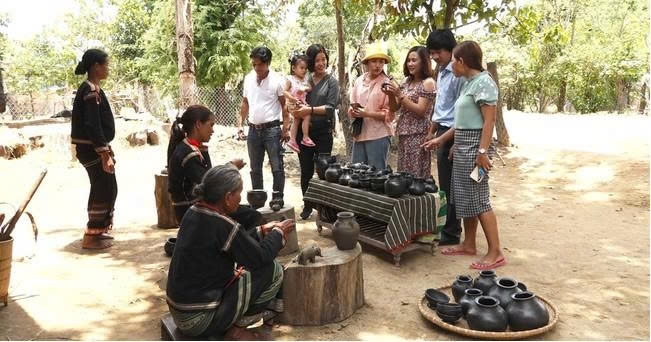
 Tourists visit and learn about the pottery of the Mnong people
Keywords: Cultural identity; Local ethnic minorities; Central Highlands; Poverty eradication; Sustainable development; Culture and development; Endogenous resources; Ethnic policy.
1. Introduction
National cultural identity is a core system of values that shapes the essence of a community, contributing to maintaining social stability and creating intrinsic strength for sustainable development. For the local ethnic minorities in the Central Highlands, where diverse traditional institutions, folk knowledge systems and unique cultural living spaces coexist, cultural identity not only reflects their worldview and philosophy of life but is also closely linked to their mode of production, community relations and social structure.
However, in the process of industrialization, modernization and international integration, the Central Highlands region is simultaneously facing two major challenges: (1) the poverty rate is still high, unevenly distributed and prolonged in ethnic minority communities; (2) the erosion, disruption or assimilation of traditional cultural values due to the impact of migration, urbanization, livelihood pressures and undirected external interference. In practice, many poverty reduction programs implemented in the region still leaning towards an economic and administrative approach, while failing to fully integrate cultural elements as an important intrinsic resource for development.
From a theoretical perspective, the relationship between cultural identity preservation and socio-economic development is not linear or antagonistic, but rather reciprocal and intertwined. Cultural preservation is not only a humanitarian or ethical goal, but also a sustainable development strategy that contributes to strengthening the community’s ability to adapt to social change. In particular, when culture is actively and properly utilized through community tourism, the development of traditional crafts, the preservation of indigenous knowledge,… it will become an effective economic lever and a means of poverty reduction.
Based on this reality, researching and proposing a development model that integrates cultural identity preservation with poverty reduction goals has become urgent, especially in the context of shaping ethnic policies for the period of 2021-2030. This article aims to analyze the relationship between cultural preservation and poverty reduction from both theoretical and practical perspectives in the Central Highlands region, in order to create a scientific basis for formulating socio-cultural policies linked to sustainable development in the local ethnic minority areas.
2. Research results
2.1. An overview of the cultural characteristics of the local ethnic minority groups in the Central Highlands
The Central Highlands region is the long-standing home of many local ethnic minority communities, such as the E-de, Mnong, Ba-na, Gia-rai, Xo-dang and Co Ho... Each ethnic group possesses a unique, rich, and multifaceted cultural system, formed through a long process of survival in its characteristic ecological environment, where forests, mountains, rivers, streams and red basalt soil are not only natural conditions but also symbolic and spiritual spaces. The culture of these ethnic groups do not exist in isolation, but rather blend together into a unique whole, playing a fundamental role in maintaining ethnic identity, regulating community life and transmitting knowledge between generations.
One of the most prominent characteristics of the culture of the ethnic groups in the Central Highlands is their strong sense of community and high symbolic value. The communal house - a typical architectural symbol is not only a shared living space but also a cultural and social center, a place where rituals converge, where collective memories are preserved and to be a physical manifestation of spiritual power within the community. Furthermore, traditional festivals linked to the agricultural production cycle and polytheistic beliefs reflect a unique worldview where humans live in harmony with nature and the spiritual realm.
The Central Highlands Gong Music Space recognized by UNESCO as a Representative Intangible Cultural Heritage of Humanity is clear evidence of the high level of cultural creativity. Gongs are not simply musical instruments; they are the voice of the gods, the language of spirituality and to be a record of community memory through sound. In daily life, the local language, the treasure trove of folk tales, indigenous knowledge about forests, medicinal plants, plant species, the art of weaving brocade, wood carving, cuisine,… all demonstrate the richness of tangible and intangible culture. Furthermore, traditional social institutions, particularly the roles of village elders, artisans and customary laws, remaining important in community governance, regulating social relations and transmitting folk knowledge. However, it is precisely the oral and unwritten nature of these values that makes them vulnerable to the impacts of modernization, migration, cultural commercialization and changing livelihoods.
A prominent feature of the culture of the local ethnic minorities in the Central Highlands is its openness and high adaptability, while still preserving the core of their identity, demonstrated through the selective adoption of external elements without losing their essence. This characteristic facilitates the integration of culture into development, but it also requires a deep understanding and a cautious approach, otherwise identity may be assimilated or formally “industrialized”.
It can be said that the culture of the local ethnic minorities in the Central Highlands is not only a valuable cultural asset of each community, but also an important resource for development if it is preserved, promoted and organically integrated with socio-economic goals. A thorough understanding of cultural characteristics is not only a prerequisite for conservation efforts but also a foundation for designing appropriate, sustainable and distinctive poverty reduction models.
2.2. Cultural preservation: From the kitchen to the communal house roof
Culture is not something distant, confined to museums or solemn ceremonies. The culture of the local ethnic minorities in the Central Highlands is most vibrant in their daily lives: in the sound of pestles pounding rice, the scent of kitchen smoke clinging to hair, the hoarse voices of storytellers under the firelight, and even in the way the community together builds the communal house - the shared roof of spirit and identity.
Firstly, culture begins in the kitchen - the place where the flame of identity is kept alive.
In many longhouses of the E-de people, or stilt houses of the Gia-rai and Mnong people, the kitchen is not only a place for cooking, but also a center of life and a cultural symbol - a place that reflects how people treat their ancestors, deities and the community. The fire in the hearth should never be allowed to go out, as it symbolizes survival, a connection to the past and previous generations.
From the kitchen, the mother teaches her daughter how to cook a traditional soup, how to boil medicinal herbs from the forest and how to tell a folk tale through each dish. It is the place where mother tongues, customs and etiquette are transmitted and where cultural inheritance takes place most naturally. These values, if not cherished, it will be lost in the rush of industrialization, as young people leave their villages for the city and charcoal stoves are gradually replaced by gas and electric stoves - more convenient but lacking in cultural soul.
Secondly, the communal house - with its high roof provides shelter for the community spirit.
If the kitchen is the place of origin, then the communal house is the embodiment of the community culture of the Central Highlands. The communal house is not only a unique architectural structure with its soaring roof, wooden floor and traditional patterns, but also the “political, cultural and spiritual center” of the village. Here, agricultural festivals, rituals to worship deities, community conferences, coming-of-age ceremonies, wedding ceremonies and even customary punishments… are all held.
Notably, the communal house does not belong to a single family, but to the entire village. Building the communal house is an opportunity for the entire community to participate, from cutting forest trees and carving pillars to making the thatched roof and erecting the frame - reflecting the spirit of solidarity and the mechanism of sharing community responsibility. Each pillar and each carved pattern contains a story of history, beliefs and the unique identity of each ethnic group.
Inside the communal house, the elders recount epic poems passed down through generations, legends of land reclamation and stories that teach how to be a good person. It is here that the younger generation “drinks from the source” a form of informal education deeply rooted in local culture, helping to affirm national identity and strengthen a sense of community.
Thirdly, cultural preservation means preserving living spaces where culture is still practiced.
Therefore, preserving the culture of the Central Highlands cannot simply stop at “preserving” material artifacts (such as gongs, communal houses and brocade fabrics), but more importantly, it is about preserving the space where cultural practices take place, where values are lived, transmitted and developed in the most natural way.
That is why the concept of “living heritage” is particularly important. A set of gongs only truly becomes meaningful when used in a festival, with someone who knows how to play them and someone who can listen and understand the message. A communal house is only truly a heritage site when a community still lives and practices there and not just a “cultural model” serviced for tourism or ceremonial display.
Culture, ultimately is a way of life, a symbolic form of social behavior. Keeping the flame burning from the kitchen all the way to the communal house roof is a journey of rebirth and sustainable cultural operation within the community, rather than “framing” it within formal preservation programs that lack the participation of the cultural subjects themselves.
Fourthly, from living culture to cultural livelihoods: Opportunities for sustainable development.
When culture is properly preserved and “lives”, it is not only a spiritual asset but also a resource for development. From reconstructing the fireplace in community homestays, organizing communal house activities, performing gong music, and preparing local cuisine for tourists, all of these can become new livelihoods, helping the people increase their income while preserving their cultural identity.
Some models in the provinces of Gia Lai, Kon Tum (now Quang Ngai province), and Dak Lak have begun to integrate culture into community tourism development, creating a “living” space for communal houses, hearths and ethnic cultural life. However, for these models to develop sustainably, they require long-term policy support mechanisms, skills training and most importantly: empowering communities to take ownership of their own culture.
Keeping the fire burning in the kitchen and the warmth under the communal house roof is not only a way to preserve cultural identity, but also a prerequisite for culture to become the foundation for sustainable development in the ethnic minority areas of the Central Highlands. It is a journey that cannot be accomplished through imposed external interventions, but must begin with empowering communities to practice their culture, allowing them to tell their own stories through their own language, rituals and way of life.
2.3. A culture of living is the foundation for the poor to stand firm
2.3.1. Culture is not just a heritage - it is an intrinsic force for development
In modern social science, particularly in theories of sustainable development, culture has been repositioned not only as an additional dimension, but as a fourth pillar alongside economics, society and the environment (UNESCO, 2013). Accordingly, culture is not only an object to be preserved, but also an endogenous resource that plays an essential role in shaping perceptions, promoting social participation and enhancing the self-reliance of communities.
In this context, the term “living culture” is used to refer to cultural practices, expressions, knowledge and values that are maintained, reproduced and applied in the daily life of a community. Unlike “preserved culture” which is static and displayed, “living culture” refers to practices that can adapt, evolve and play an active role in the survival, livelihood and development strategies of a community.
In ethnic minority regions in general and the Central Highlands in particular, where many deeply rooted traditional cultural forms exist, “living culture” plays a particularly important role in the lives of the poor - not only as a spiritual element, but also as a basis for them to form their personal identity, maintain community cohesion and establish livelihood models suitable to the specific natural and social conditions.
2.3.2. Cultural identity is a mechanism for social adaptation and sustainable livelihoods
From a developmental anthropological perspective, cultural identity is not merely a symbol of the past, but a present-day tool for communities to adapt to environmental and social changes. Factors such as local knowledge, traditional production practices, agricultural cycle rituals, customary laws and the role of village elders not only help maintain community order but also mitigate social risks when formal institutions are not yet fully effective.
For example, customary law systems and the role of village elders in Central Highlands communities not only help with internal governance but also regulate land conflicts, marriages and resource sharing, creating a community-based social safety net that the State cannot always replace. This is a special form of “social capital” that can help the poor overcome difficulties without relying entirely on external resources.
Furthermore, cultural identity also forms the basis for developing livelihood models based on cultural resources, such as brocade weaving, traditional crafts, community tourism and forest canopy farming using local knowledge… These models not only generate income but also retain people in their villages, fostering community ties and national pride, factors that are far more effective than purely subsidy policies.
2.3.3. Culture and multidimensional poverty: An integrated problem and a humanistic approach
According to the United Nations Development Programme (UNDP)’s multidimensional approach to poverty, poverty is not just a lack of income, but also a lack of access to education, healthcare, information, social participation and decision-making capacity. Within this approach, culture acts as a “soft empowerment” tool, helping people shape their identity, affirm their personal values and actively participate in social life.
Treating culture as an integral part of the development process not only enhances policy effectiveness but also avoids the risks of imposed development models, which can easily provoke negative reactions or lead to the loss of community roots.When culture is stripped away, people lose their spiritual anchor, their guiding values and are more likely to become passive, dependent or assimilated into stronger cultural, economic and social influences from the outside.
Conversely, when culture is recognized as a foundation for development, people will feel respected and motivated to preserve and master their local knowledge. This ensures both sustainable economic development and strengthenig social stability, while also improving the quality of life in the fullest sense.
2.3.4. Living culture and poverty reduction strategies: Inseparable.
From the above analysis, it can be affirmed that culture is not a “luxury” reserved only for the wealthy, but on the contrary, it is the foundation upon which the poor can stand firm. Preserving and promoting “living culture” should be placed within the poverty reduction strategy as an integrated, overarching axis, rather than as an independent or auxiliary area.
Specifically, poverty reduction programs in the ethnic minority areas of the Central Highlands need to be restructured in the following direction: (1) Integrating local knowledge and community culture into livelihood model building; (2) Developing traditional crafts and cultural products into economic tourism value chains; (3) Strengthening indigenous culture education in schools, especially at primary and lower secondary (junior high school) levels in remote areas; (4) Respecting the role of traditional social institutions in community governance and poverty reduction program operation; (5) Empowering communities to take ownership of the development process, based on their own cultural identity and resources.
“Living culture” is not a past value to be preserved, but a present and future resource for ethnic minority communities. In the Central Highlands - a region where poverty and social risks still persist, culture if properly utilized, can be fertile ground for developing effective, sustainable and distinctive poverty reduction models. In order to enable the poor not only to escape material poverty but also to stand firm in their own identity - that is the deepest and most humane meaning of culturally-based development.
2.4. Practical experiences in the Central Highlands - From the sound of gongs to the familiar cloth table
The Central Highlands - a land of vast forests, where the echoes of gongs blend with the scent of kitchen smoke, the vibrant colors of brocade fabrics and the enduring rhythm of local communities is facing a major crossroads: either lose its identity in the wave of marketization, or leverage that very identity as an endogenous resource for sustainable development. Current practice shows that both trends coexist, reflecting the dual nature of the development process if a sound cultural strategy is lacking.
Firstly, the gong: A fading heritage or a cultural asset that can create livelihoods?
Nowhere else in the Central Highlands do sounds possess such soul as the sound of gongs and drums. It’s not just music, but a “spiritual language”, a “collective memory repository”. Gongs were once closely associated with agricultural festivals, the human life cycle and religious rituals. However, in modern life, as festivals become less frequent and young people leave their villages, in many places gongs and drums are merely artifacts or “tourist performances” on a fixed schedule, losing their inherent sacredness, naturalness and community spirit.
However, there are still some bright spots. In Dak R’tih (Dak Nong) or Kon K’tu (Kon Tum, now Quang Ngai), artisans like A Blong and Y Duong still diligently teach gong playing to the younger generation, organizing informal classes right in the communal house. Some localities, such as Gia Lai have integrated the restoration of the gong culture space into community tourism, creating cultural and tourism products that can be commercialized without losing their spiritual value.
Such models demonstrate that gongs do not need to be “museumized”, but can absolutely “live” and “make a living” if properly empowered, with coordination between artisans, the community and local authorities.
Secondly, the familiar weaving table: Weaving brocade is not only a tradition, but also the economic future.
In many villages of the E-de, Mnong and Ba-na ethnic groups, the rustling sound of the loom is not only the sound of a traditional craft, but also the sound of their livelihood. Traditional brocade weaving not only preserves cultural memories through its patterns but is also gradually becoming a valuable local craft with economic potential.
In fact, models such as the brocade weaving cooperative in Tuor village (Dak Lak province) or the family weaving groups in Kon Tum (now Quảng Ngãi province) and Gia Lai have created stable jobs for hundreds of ethnic minority women, while preserving the valuable heritage of traditional weaving. When brocade products are improved in design, linked to cultural stories and reach the tourism and online markets, they become “carryable cultural products”, helping to increase income while promoting cultural identity.
However, many craft villages are still facing obstacles: lack of capital, lack of sustainable markets and lack of links with tourism or regional branding. In many places, the revival of the weaving craft has only gone as far as “reviving it for reporting purposes” and has not truly become part of daily life. This shows that cultural preservation must be linked to transforming it into a livelihood and cannot be simply displayed.
Thirdly, integrated models: When culture becomes the core of poverty reduction.
Some development models have initially succeeded in integrating culture with poverty reduction, such as: (1) Kon K’Tu community tourism village (Kon Tum now Quang Ngai): combines communal house, festivals, gongs, brocade weaving and traditional dishes into tourism products; creates jobs for local people, keeps young people in the village. (2) Model of growing medicinal plants under forest canopy in Dak Glei (Kon Tum): integratinglocal knowledge about medicinal plants into economic development; both sustainably exploiting forest resources and helping people preserve the traditional medicine knowledge of the Xo Dang ethnic group. (3) Cultural markets in Dak Nong and Lam Dong: where traditional cultural products (food, brocade, musical instruments, medicinal plants,...) are exchanged as part of the local economy.
In particular, the common thread among successful models is that the community is empowered with cultural ownership has been empowered in terms of livelihoods and receiving support in accessing markets and skills training.
Fourthly, existence and challenges: When culture is not yet seen as a true “resource for development”.
Despite its great potential, the reality in the Central Highlands still reveals a common situation: culture has not been effectively integrated into poverty reduction programs. Cultural and tourism models remain fragmented and lack interconnectedness; “restoration” lacks depth; support policies for artisans are limited; and language, education and market access barriers prevent many ethnic minority communities from “transforming culture into livelihood”.
Furthermore, some development programs have inadvertently harmed the culture: turning festivals into performance stages for tourists; demolishing traditional longhouses to build single story houses; providing “vocational training” without considering the socio-cultural needs of each community.
This highlights the urgent need for a “bottom-up” approach, meaning one that starts from the real needs of the community and its vibrant cultural identity, rather than from administrative frameworks.
From the distant sound of gongs to the intimate setting of cloth tables, the realities in the Central Highlands show that culture is not just a heritage, but a valuable asset that can generate profit if its role is properly recognized and promoted through appropriate policies and mechanisms. Preservation is not about storing things away, but about preserving them so that communities can live, live well and live proudly with their own identity. It is a path that must be taken slowly, but sustainably, if we want to eradicate poverty not just on paper, but in every kitchen, every communal house and every village of the vast Central Highlands.
2.5. The challenge is real - when culture is not treated appropriately, it can easily lose its roots
In the course of development, culture, if not properly identified and treated wisely, will not only fade away but also become a silent victim of the very strategies for poverty reduction. Experience in the Central Highlands shows that many development programs, with economic goals at their center have inadvertently damaged or disrupted the underlying cultural threads that have anchored the identity and strong community structure for hundreds of years.
a) The pressures of globalization and the marketization of identity.
In the era of globalization, ethnic minority communities in the Central Highlands are facing a double pressure: on the one hand, there is the dominance of digital culture and popular culture; on the other hand, there is the superficial commercialization of identity, leading to the phenomenon of “borrowing form, losing spirit”.
In many places, gongs, festivals, communal houses... have become “tourism products”, being modified and staged according to market demands. As a result, sacred values and profound cultural significance are eroded, while the community, the subject of the culture is pushed to the margins of its own heritage.
For example, in some reenactment festivals, people are hired to wear traditional costumes, playing gongs and performing according to a pre-written script, without fully understanding the meaning of the ritual. When culture becomes a “performance backdrop” instead of a way of life, it loses its ability to nurture the spirit or develop sustainable livelihoods for the community.
b) “Preserving form” - a lax but dangerous approach.
One of the serious challenges is the administrative and formalistic approach to conservation, that is, preserving heritage through registration, documentation and the creation of “traditionalization” models, without regard for the vibrant social context of the community. This approach often leads to several problems such as: (1) Conservation without users: New communal houses have been built, but no one uses them; festivals are held but there is a lack of practitioners with deep understanding of the traditions; (2) Heritage is separated from the practice space: Gongs are stored in cultural centers and no longer resonate in daily life; (3) Artisans are not properly treated: People with traditional cultural knowledge do not have a commensurate social status, gradually abandoning or being forgotten.
Identity, if “framed” as a static object, cannot be passed down through generations. In that case, preservation is no longer about saving culture but a ritualistic farewell to a value that is silently dying.
c) Losing a language means a breakdown in the transmission of knowledge - a disruption of identity.
Language is the soul of culture. However, the decline of mother tongues among ethnic minorities in the Central Highlands is currently occurring at an alarming speed. According to the Report of the Ministry of Education and Training (2022), the percentage of ethnic minority students who can use their mother tongue proficiently in daily life is decreasing. The language is not formally taught in schools, lacking public spaces for practice and is gradually being replaced by the standard Vietnamese language.
This has led to a breakdown of local knowledge and cultural practices: chants are no longer passed down, forest-cycle farming techniques are replaced by industrial agricultural models and folk remedies are lost because young people no longer learn the vocation...
The disappearance of local languages and knowledge is not only a cultural loss, but also a significant loss of social capital and the community’s ability to develop independently. When a community no longer understands or can no longer tell its own story, then escaping material poverty cannot conceal its spiritual poverty.
d) Unsustainable development - when policies fail to penetrate the culture.
Many current poverty reduction policies are still heavily reliant on a “top-down” approach, lacking genuine community participation. Livelihood support programs have not taken into account local socio-cultural factors, leading to the application of a single model to many ethnic groups with different value systems.
For example, changing crop and livestock practices in ethnic minority areas without considering the connection between farming and rituals; vocational training is provided for ethnic minority women, but this separates them from their traditional roles in the family and community; New housing construction follows standardized procedures, completely eliminating cultural spaces such as kitchens, festival grounds and communal houses…
Development that is not integrated with culture is unlikely to be sustainable. Culture, if viewed as a burden or an auxiliary element, cannot coexist with the economy in the long term and risks serious damage.
Cultural identity, if not recognized as a vibrant and adaptable system of values is easily eroded in the very process of development.
A mindset focused on preserving cultural forms, promoting non-cultural development, or exploiting identity in an extreme, market-driven way can uproot vulnerable communities, leaving them without a foundation to continue their journey out of poverty and towards sustainable development.
Appropriate and wise behavior towards culture does not mean being conservative or clinging to the past, but rather knowing what to preserve, what to adapt to, and most importantly: in order to allow the community to speak its own language, practice its own culture and develop on the foundation of its own identity.
2.6. Proposing policy solutions to promote an integrated approach between culture and development, centered on the community, towards the goal of sustainable development in the ethnic minority areas of the Central Highlands
In the context of the rapid transformation of modern society and the need for sustainable poverty reduction, integrating culture into development strategies is one of the key elements to ensure that no one is left behind, especially in the local ethnic minority areas of the Central Highlands. Experience shows that only when communities are empowered to take ownership of their identity and livelihoods can they both preserve their culture and create the intrinsic motivation to escape poverty.
From the perspective of public policy and sustainable cultural development, systemic, in-depth solutions that place the community at the center are needed, such as the following:
Firstly, developing policies based on local cultural identity and knowledge.
This direction aligns with the orientation outlined in the Strategy for Cultural Development until 2030 (Decision No. 1909/QD-TTg dated November 12th, 2021, of the Prime Minister: Regarding the approval of the Cultural Development Strategy until 2030), this emphasizes the promotion of national cultural values in economic and social development.
Secondly, designing a flexible institutional and financial framework that ensures community ownership.
The experiences of both UNESCO and UNDP emphasize that the sustainability of cultural development programs linked to poverty reduction can only be achieved when communities are involved from the design to the implementation stage (UNESCO, 2018; UNDP, 2020).
Thirdly, we need to innovate in the education of national culture - from schools to communities.
Therefore, developing the cultural capacity of the younger generation is essential for sustainably safeguarding the cultural future.
Fourthly, developing a set of criteria for evaluating cultural development integrated with multidimensional poverty reduction.
In order to ensure that culture is effectively integrated into development policy, we need to establish the following criteria: (1) System of cultural assessment indicators in sustainable development: such as the percentage of people using their mother tongue, the level of participation in rituals, the number of active artisans, the percentage of people with livelihoods from traditional crafts… (2) Integrating cultural indicators into multidimensional poverty assessment, following the approach of UNDP and UNESCO, in order to ensure not only income improvement, but also improved quality of life in terms of spirit, identity and access to heritage.
Fifthly, strengthen communication to change perceptions - viewing culture as a resource for development.
In many places, traditional culture is still viewed as “outdated”, hindering development and in need of replacement. This is an incorrect perception that needs to be changed through: (1) A community communication campaign on the value of culture in development, targeting both people, government and businesses; (2) Honoring artisans, village elders and community leaders as “living cultural leaders”; (3) Encourage young people to become “new guardians” through content creation, social media, cultural tourism… Only when culture is positioned as a valuable asset, not a “burden of the past”, will it have the opportunity to thrive and continue to evolve alongside development.
Sixthly, culture is the foundation, it is not an accessory.
By systematically integrating culture into poverty reduction policies, based on local knowledge and with communities at its core, Vietnam is not only aiming for sustainable development in the Central Highlands, but also protecting one of the most precious cultural treasures of the nation and humanity.
Seventhly, when the roots are not lost, the people will be strong.
If done correctly, culture will be what creates a sustainable, joyful and rooted life, not just as a legacy, but as an instinct for upward striving. It was at that moment that culture was not only preserved… but revived, flourished and became a lifeline helping the people of the Central Highlands overcome poverty and reach a stable future.
3. Discussion
Firstly, culture as a “cultural capital for development”.
The concept of “cultural capital” developed by Pierre Bourdieu in his classic sociological works, emphasizes that cultural values, practices and symbols can be transformed into socio-economic benefits if properly positioned and empowered. In the Central Highlands, cultural capital exists in many forms: (1) Symbolic capital: such as festivals, gongs, longhouse architecture, fertility beliefs; (2) Local knowledge capital: knowledge of slash-and-burn farming, healing with forest medicinal plants, customary laws; (3) Community social capital: kinship relations, the role of village elders, traditional forms of self-governance.
Secondly, the relationship between conservation and development: Theory and practice.
Sustainable development theory asserts that culture is one of the four main pillars (alongside economy, society and environment) reaffirmed in the Hangzhou Declaration (UNESCO, 2013) and the United Nations Development Programme (UNDP, 2020). However, in the Central Highlands, a persistent paradox exists: On the one hand, culture is seen as a “tradition that needs changing” for modernization. On the other hand, this very cultural heritage is being exploited for tourism in a commercialized and unoriginal way.
Thirdly, a culture-centered development approach: Innovation is necessary.
Some works by Amartya Sen and the UNDP research team have proposed a capacity-based development model, which means not only improving living standards, but also enhancing the ability to “do what one cherishes and become the person one wants to be”. Accordingly, cultural preservation should not only be about preserving memories, but also about creating conditions for communities to live by culture, within culture and for culture.
Therefore, in the Central Highlands, this requires a new approach, such as: (1) Not imposing a foreign livelihood model, but seeking economic value from traditional cultural practices; (2) Do not build new communal houses for “show”, but restore the social, ritual and educational functions of communal houses in the community; (3) Not to provide short-term vocational training in a fragmented manner, but to support the formation of local value chains associated with brocade, traditional cuisine, medicinal herbs, tourism festivals,…
At that point, culture will no longer be a burden of “preservation”, but will become a resource for sustainable development, in line with the spirit of Resolution No. 88/2019/QH14 dated November 18th, 2019, of the National Assembly: Approving the overall plan for socio-economic development of ethnic minority and mountainous areas for the period of 2021-2030: It is centered around people, with culture as the foundation and the community as the subject.
Academic discussions on the relationship between culture and poverty reduction in ethnic minority areas need to be approached not only from a development theory perspective, but also from the specific experiences of the local communities. The Central Highlands, with its rich heritage and strong local character is a “living laboratory” for sustainable cultural development models if there is adequate policy investment, multidisciplinary academic collaboration and especially genuine participation from the people themselve, those who live, breathe and preserve that culture every day.
4. Conclusion
Preserving cultural identity should not and cannot be separated from socio-economic development strategies, especially in the indigenous ethnic minority areas of the Central Highlands, where culture is not just memory, but a way of life, a system of values that creates community strength. Sustainable poverty reduction, therefore, cannot simply be about raising incomes, but must also empower people to preserve their identity, unleash their cultural potential and revive local capital as a core part of development.
Experience shows that when culture is viewed as a resource, rather than an obstacle, ethnic minority communities can both remain strong in their identity and proactively create sustainable livelihoods. This requires a shift in policy from an administrative and technical approach to an integrated, interdisciplinary approach with genuine community participation. At the same time, development models need to be designed flexibly within a dynamic culture, without imposition, contextual bias.
The Central Highlands region is not lacking in resources both natural and spiritual heritage but it lacks policies that are sufficiently in-depth, long-lasting and that place sufficient faith in the local intelligence. When the poor can live by their own culture, that is truly sustainable development - development that has roots, soul and a future.
* Principal of Nha Trang Central University Ethnic Preparatory School
** Institute of Ethnic regional Economics
*** Nguyen Tat Thanh University, Ho Chi Minh City
References
1. Liem Anh, Huong Giang. (2025). Focusing on educating ethnic minority boarding school students to preserve their mother tongue. https://giaoducthoidai.vn/chu-trong-giao-duc-hoc-sinh-dan-toc-noi-tru-gin-giu-tieng-me-de-post739583.html.
2. Phan An. (2015). Cultural identity and sustainable development in ethnic minority areas: Issues raised. Journal of Social Sciences, Vietnam Academy of Social Sciences.
3. Duy Dung, “Factors influencing community tourism on the culture of ethnic minorities”, Tourism Magazine, August 2016 issue.
4. Nguyen Duy Dung (2021), “The Impact of Community-Based Tourism on the Traditional Culture of Ethnic Minorities in the Central Highlands”, Front Magazine, No. 209+210 (January+February).
5. Nguyen Van Huy. (2010), Cultural heritage and sustainable development in Vietnam. Culture and Arts Magazine, (12).
6. Resolution No. 88/2019/QH14 dated November 18th, 2019, of the National Assembly: Approving the overall plan for socio-economic development of ethnic minority and mountainous areas for the period of 2021-2030.
7. Prime Minister. (2021), Decision No. 1909/QD-TTg of the Prime Minister: On approving the Strategy for Cultural Development until 2030.
8. UNESCO. (2013), Hangzhou Declaration: Placing Culture at the Heart of Sustainable Development Policies.
9. UNDP. (2004), Cultural Liberty in Today’s Diverse World - Human Development Report. United Nations Development Programme.
10. UNESCO,. & UNDP (2020), Culture in Crisis: Policy guide for a resilient creative sector.
11. Tran Huu Son. (2022), The cultural space of the Central Highlands gong culture and lessons for sustainable preservation. Journal of Ethnology, Central Highlands special issue.
12. Institute of Ethnology. (2020), Report on the investigation of the current state of cultural changes among ethnic minorities in the Central Highlands. State-level Research Theme.
